




Amazon Calculator Profit 2026: Pro Seller Guide to Real Earnings
In 2026, Amazon calculator profit selling is no longer about just listing products—it is about precision, data, and margin control. Every successful seller understands one truth: revenue means nothing without accurate profit calculation.
The system has become a core decision-making tool for sellers who want to scale sustainably. Whether you are running Private Label, Wholesale, or Arbitrage, profit visibility defines your survival.
This guide breaks down Amazon profit calculation at a professional level—covering fee structures, margin engineering, pricing psychology, and real-world seller strategies.
Step-by-Step Amazon Calculator Profit Guide 2026 Video for Sellers
Understanding Amazon Profit Analysis at a Professional Level
At its core, an Amazon profit calculator is not just a tool—it is a financial modeling system for eCommerce sellers.
It simulates your product lifecycle and calculates net profit after deducting:
- Amazon referral commissions
- FBA fulfillment costs
- Storage fees (short & long-term)
- Shipping and inbound logistics
- PPC and acquisition cost
- Product sourcing cost
But advanced sellers don’t just calculate profit—they analyze profit sensitivity, meaning how each variable affects margins at scale.
Core Profit Formula Used by Amazon Sellers
Professional sellers rely on a refined model:
Net Profit=(SP×Q)−(Cp+Famazon+Flogistics+Fads)\text{Net Profit} = (SP \times Q) – (C_p + F_{amazon} + F_{logistics} + F_{ads})Net Profit=(SP×Q)−(Cp+Famazon+Flogistics+Fads)
Where:
- SP = Selling Price
- Q = Quantity Sold
- Cₚ = Product Cost
- Famazon = Amazon fees
- Flogistics = Shipping & fulfillment
- Fads = Advertising cost
This equation is not static—it evolves with scale, seasonality, and marketplace competition.
Why Amazon Calculator Profit is Critical in 2026
Amazon has matured into a high-competition ecosystem. Profit errors of even 2–5% can destroy scaling potential.
Strategic Importance:
1. Margin Protection at Scale
When you scale from 10 to 1000 units, small fee miscalculations multiply into major losses.
2. Product Filtering System
Professionals reject 70%+ product ideas based on calculator results before launching.
3. Pricing Architecture
It defines whether a product sits in:
- Premium pricing tier
- Competitive mid-range
- Aggressive low-margin strategy
4. Ad Spend Control
PPC campaigns are only viable when the profit baseline is validated first.
Breakdown of Amazon Fee Structure
To use any amazon calculator profit effectively, you must understand Amazon’s layered cost structure.
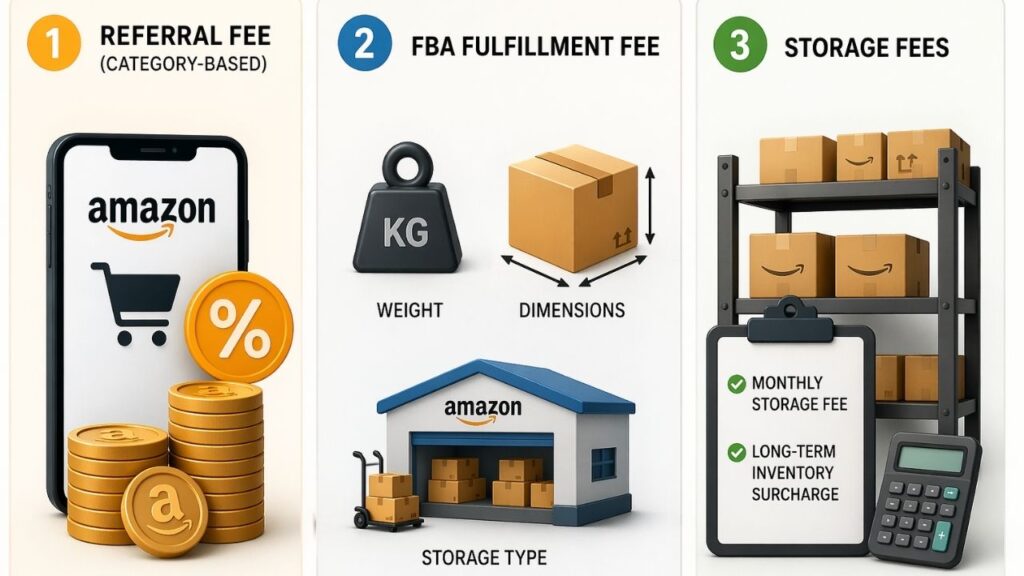
1. Referral Fee (Category-Based)
Amazon charges a percentage of selling price depending on category:
- Typically 8%–15%
- Can go higher for niche categories
2. FBA Fulfillment Fee
This is based on:
- Weight
- Dimensions
- Storage type
3. Storage Fees
Two categories:
- Monthly storage fee
- Long-term inventory surcharge
4. Closing Fees (Certain Categories)
Applicable to media and select product types.
5. Advertising Cost (PPC)
Not mandatory—but in 2026, no serious seller operates without ads.
FBA vs FBM Profit Comparison (Strategic View)
FBA Model
- Higher conversion rate
- Faster delivery (Prime badge)
- Higher fees
FBM Model
- Lower fees
- Full control over logistics
- Lower conversion rate in competitive niches
Profit Reality:
Most sellers assume FBM is cheaper—but at scale, FBA often generates higher net profit due to conversion uplift.
Advanced Profit Scenarios
Instead of one calculation, professionals run multi-scenario profit models:
Scenario 1: Base Price Model
Normal selling price with standard PPC.
Scenario 2: Discount Strategy Model
Temporary reduced price to increase ranking velocity.
Scenario 3: High PPC Acquisition Model
Aggressive ad spending for market entry.
Scenario 4: Organic Scaling Model
Reduced ads after ranking stability.
Each scenario gives a different profit curve, not a single static number.
Common Mistakes That Kill Amazon Profit
1. Ignoring Dimensional Weight Impact
Small size changes can increase FBA fees significantly.
2. Blind Pricing Based on Competitors
Competitor price ≠ competitor profit.
3. No PPC Inclusion in Calculation
Many sellers calculate profit without ads—this is unrealistic.
4. Overlooking Return Rate
Returns can reduce net profit by 3–10%.
5. Static Pricing Strategy
Amazon pricing is dynamic; profit calculations must be continuous.
Expert-Level Profit Optimization Strategies
✔ Reverse Engineering Competitor Margins
Instead of copying prices, analyze what competitors can actually afford.
✔ Packaging Optimization
Reducing product dimensions can lower FBA tier costs.
✔ Supplier Cost Negotiation
Even 5% cost reduction dramatically increases long-term margin.
✔ Keyword-Based Pricing Strategy
High-ranking keywords allow premium pricing.
✔ Inventory Velocity Optimization
Faster turnover reduces storage fees and improves cash flow.
Amazon Calculator Profit vs Real Seller Profit
| Factor | Calculator Result | Real Market Result |
| Fees | Estimated | Dynamic |
| Ads | Optional | Mandatory |
| Returns | Ignored | Real impact |
| Competition | Static | Changing daily |
👉 This is why professionals treat calculators as decision tools, not final truth.
Scaling Strategy Based on Profit Data
Once profit is validated, sellers follow a structured scaling system:
- Validate product margin (minimum 25–35%)
- Test PPC campaigns
- Optimize conversion rate
- Expand keyword reach
- Increase inventory gradually
- Recalculate profit monthly
This prevents cash flow breakdown during scaling.
PlugBooks Insight for Amazon Sellers
For serious sellers, manual tracking is not enough.
Platforms like PlugBooks help sellers:
- Track real-time Amazon profit
- Sync sales with expenses automatically
- Monitor FBA fees vs actual margin
- Analyze SKU-level performance
This transforms the basic amazon calculator profit concept into a full financial control system.

FAQs
1. Is Amazon profit calculator enough for scaling?
No, it is a baseline tool. Scaling requires dynamic tracking systems.
2. Why do my real profits differ from calculator results?
Because ads, returns, and competition change daily.
3. What is a good profit margin in 2026?
Professionals aim for 25%–40% depending on category.
4. Should PPC be included in profit calculation?
Yes, otherwise calculations are incomplete.
5. Is FBA more profitable than FBM?
It depends on category, but FBA often wins in conversion-driven niches.
Final Takeaway
The Amazon calculator profit system is not just a simple tool—it is a strategic profit modeling framework. In 2026, winners are not those who sell more, but those who calculate better.
If you treat profit as a continuous variable—not a fixed number—you gain a major competitive advantage in Amazon’s ecosystem.
Smart sellers don’t guess. They calculate, test, optimize, and scale.
One thought on “Amazon Calculator Profit Guide for Sellers 2026”