



Basic bookkeeping for small business is the backbone of financial clarity and growth. Many small business owners struggle to keep track of expenses, income, and taxes, but a strong bookkeeping system makes it manageable.
In this guide, we’ll explore bookkeeping basics for small business, how basic bookkeeping software for small business like PlugBooks simplifies your workflow, and actionable tips to stay organized.
Key Takeaways:
- Understand essential bookkeeping terms
- Learn step-by-step methods for recording transactions
- Discover software solutions to save time and avoid errors
- Avoid common bookkeeping mistakes
- Budget effectively for bookkeeping services
What Is Bookkeeping?
Bookkeeping is the systematic recording of all financial transactions in a business. It ensures accuracy in income, expenses, and taxes. Unlike accounting, bookkeeping focuses on daily financial tracking. Learning bookkeeping basics for small business ensures that your records are reliable and ready for reporting and analysis.
Why do small businesses need to keep track of their money?
- Tax compliance: Keeping accurate records keeps you from getting fines.
- Managing cash flow: Keep an eye on your income and expenses to stay financially healthy.
- Making decisions: Know which goods or services make money.
- Planning for expansion means finding trends and making budgets.
Basic bookkeeping software for small businesses automates many of these activities, which cuts down on mistakes and gives you more time to prepare for the future.
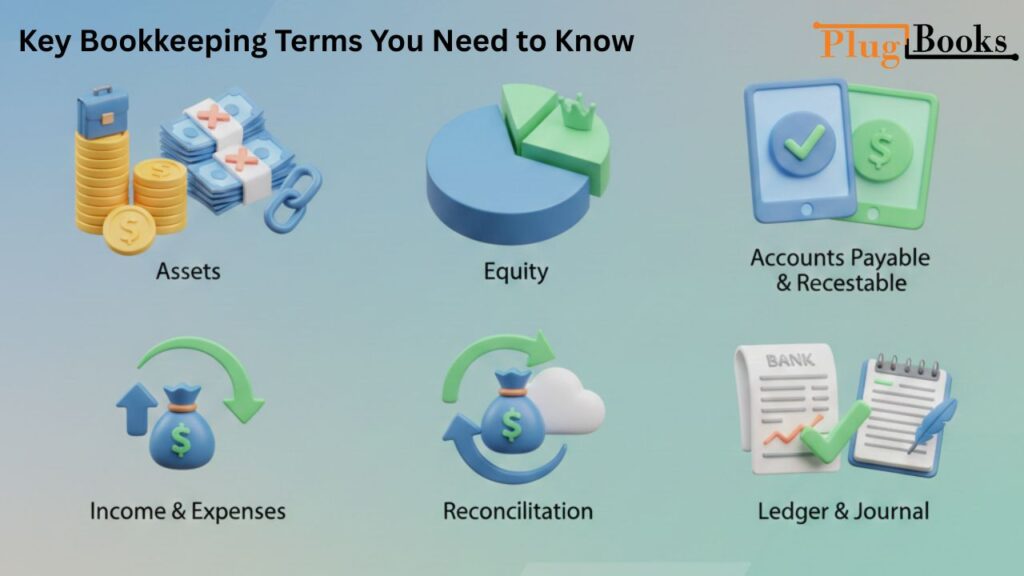
Important Bookkeeping Terms to Know:
- Assets are things that your firm owns.
- Liabilities: Debts or things you have to do
- Equity: The owner’s share in the firm
- Income and expenses: Money that comes in and money that goes out
- Accounts Payable and Receivable: Money owed vs. bills to pay
- Reconciliation: Checking that records match bank statements
- Ledger and journal: The main books for keeping track of transactions
To learn the basics of bookkeeping for small businesses, you need to know what these terms mean.
How Small Businesses Can Handle Bookkeeping
- Manual bookkeeping: Simple but time-consuming
- Spreadsheets: cheap, but you need to pay attention to the details
- Hiring a bookkeeper is a professional but costly choice.
- Automated, accurate, and scalable software solutions
PlugBooks is an example of basic bookkeeping software for small businesses that makes it easier to record, sort, and reconcile transactions.
Simplify Your Small Business Bookkeeping with PlugBooks
PlugBooks integrates with platforms like Amazon, eBay, Shopify, QuickBooks, and Xero to automatically record transactions. Features include:
- Error-free reconciliation
- Automated income and expense categorization
- Real-time dashboards for better decision-making
PlugBooks is the ultimate basic bookkeeping software for small business, saving time and stress while ensuring accuracy.

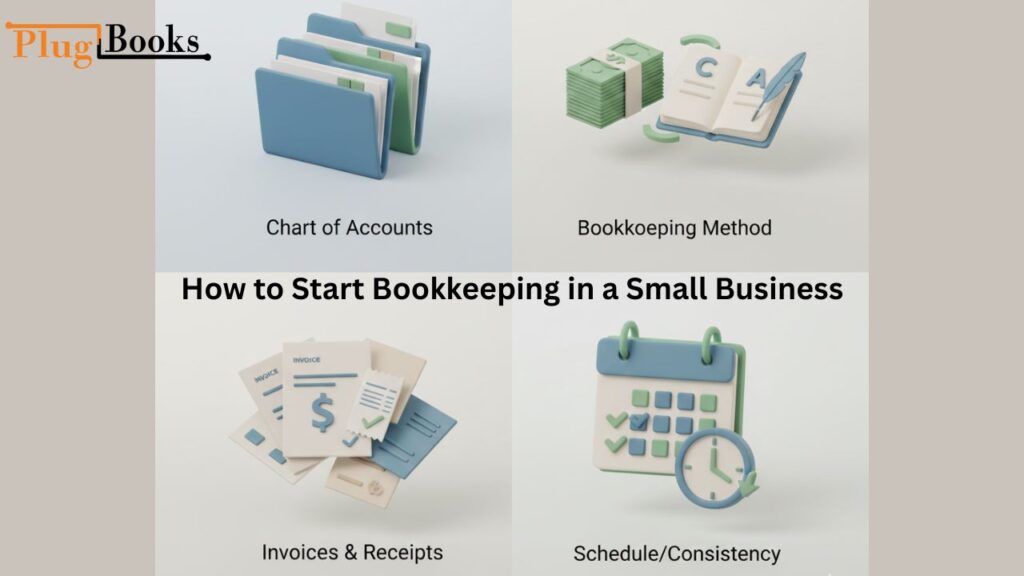
How to Start Bookkeeping in a Small Business
- Set up a chart of accounts to organize finances
- Choose a bookkeeping method: cash vs. accrual
- Organize invoices, receipts, and bank statements
- Implement a consistent schedule for updating records
Starting with bookkeeping basics for small business helps you maintain accuracy from day one.
Step-by-Step Guide to Small Business Bookkeeping
- Write down transactions every day or every week.
- Put your income and expenses into the right groups.
- Balance your bank and credit accounts
- Keep an eye on sales and inventories
- To automate these tasks, use simple accounting software for small businesses like PlugBooks.
Automation cuts down on mistakes and saves you hours every week.
Get to Know Bookkeeping Statements
- Statement of Profit and Loss: Shows how much money you made over time
- Balance Sheet: A quick look into assets, debts, and equity
- Cash Flow Statement: Shows how money moves in and out
Regularly looking over these helps you make smart business choices.
6 Tips for Small Business Bookkeeping
- Keep business and personal finances separate
- Maintain consistent record-keeping habits
- Review financial statements monthly
- Use cloud-based software like PlugBooks
- Backup your financial data regularly
- Prepare for tax season year-round
These tips make basic bookkeeping for small businesses manageable and stress-free.
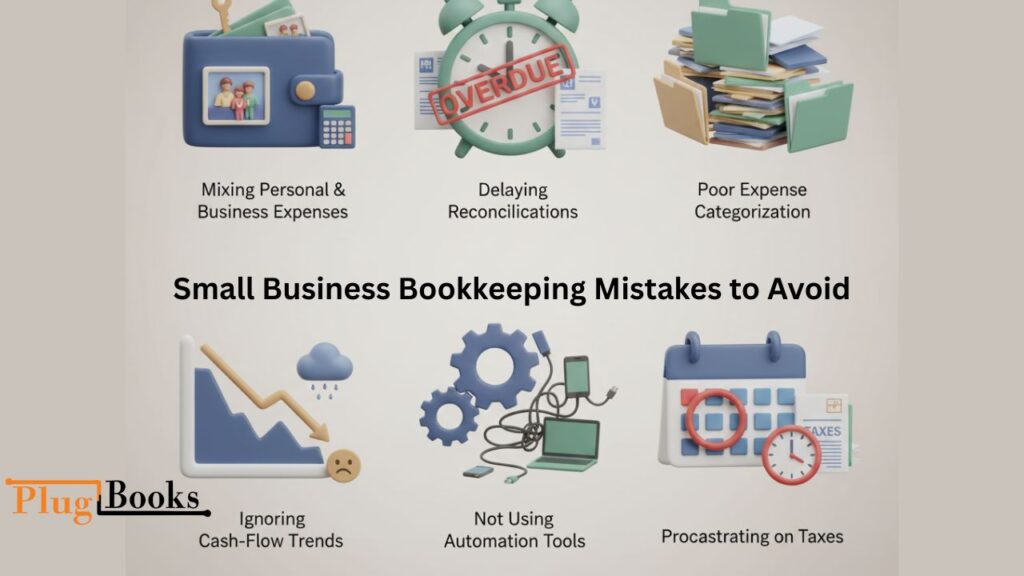
Small Business Bookkeeping Mistakes to Avoid
- Mixing personal and business expenses
- Delaying reconciliations
- Poor expense categorization
- Ignoring cash-flow trends
- Not using automation tools
- Procrastinating on tax preparation
Avoiding these errors ensures smooth financial operations.
How to Budget for Bookkeeping Services
- Compare costs of manual, software, and professional services
- Estimate monthly bookkeeping needs
- Use basic bookkeeping software for small business like PlugBooks to reduce costs
- Plan for scalable growth
Budgeting ahead prevents overspending and financial surprises.
Common Questions
Q1: As a new business owner, can I do my own bookkeeping?
Yes, however, adopting simple bookkeeping software like PlugBooks for small businesses makes sure everything is correct and saves time.
Q2: How often should I update my books?
To avoid mistakes and keep track of cash flow well, updates should be done at least once a week.
Q3: What is the difference between cash and accrual accounting?
The cash approach records transactions when money changes hands, while the accrual technique records transactions when they happen, even if payment is still due.
Q4: Does bookkeeping assist you get a loan for your business?
Keeping accurate accounting makes you look more trustworthy and makes it easier to get loans.
Q5: Is it worth it for very small firms to buy bookkeeping software?
Yes. Automation, fewer mistakes, and better reporting are good for even tiny organizations.
Q6: What is it like to use bookkeeping software in real life?
One owner of a small online store said, “Before PlugBooks, it took hours to match up Amazon and Shopify orders.” I can check my daily transactions in minutes with PlugBooks, which lets me focus on building my business. It feels like I have a virtual accountant on my team.

Quick Review
- For small businesses, basic bookkeeping is important for making things clear, helping them develop, and following the rules.
- Use basic bookkeeping for small businesses to keep your records straight.
- Basic bookkeeping software for small businesses, such as PlugBooks, makes things easier.
- Avoid making mistakes, plan your money well, and stay on track.
In conclusion
Mastering basic bookkeeping for small business doesn’t have to be overwhelming. Even busy small business owners can manage accurate finances, make smart choices, and focus on growth if they know the appropriate terms, keep records consistently, and use tools like PlugBooks. Use PlugBooks today to change bookkeeping from a boring task into a business advantage.