




1099 form vs W9 is one of the most common tax-related topics for businesses, freelancers, and eCommerce sellers. Understanding the difference between a W9 form and a 1099 form is important for businesses, freelancers, and eCommerce sellers.
A W9 collects contractor tax details, while a 1099 reports non-employee payments to the IRS. Using these forms correctly can help avoid tax errors, payment issues, and IRS penalties.
In this complete guide, you’ll learn:
- What a W9 form is
- What a 1099 form is used for
- The major differences between the two
- When businesses should request these forms
- Important IRS deadlines for 2026
- Common tax mistakes and penalties
- How online sellers can simplify tax reporting
What Is a W9 Form?
A W9 form, officially known as IRS Form W-9, is used by businesses to collect tax information from independent contractors, freelancers, vendors, and self-employed professionals.
The form itself is not sent to the IRS in most cases. Instead, businesses keep it on file to prepare other tax documents later, especially Form 1099-NEC.
Information Included in a W9 Form
A standard W9 form usually contains:
- Full legal name
- Business name (if applicable)
- Tax classification
- Address information
- Taxpayer Identification Number (TIN)
- Social Security Number (SSN) or EIN
- Signature confirming the information is correct
Who Needs to Fill Out a W9?
A W9 is commonly completed by:
- Freelancers
- Independent contractors
- Consultants
- Designers and developers
- Marketing agencies
- eCommerce service providers
- Self-employed professionals
For example, if a Shopify store hires a freelance graphic designer, the business will typically request a W9 before sending payments.
Why Businesses Request a W9
Businesses use the form to verify taxpayer details before issuing payments. This helps ensure accurate year-end tax reporting.
Without a W9, businesses may face reporting problems, backup withholding requirements, or IRS penalties.
What Is a 1099 Form?
A 1099 form is an IRS tax document used to report non-employee compensation. Businesses send this form to contractors and the IRS to report payments made during the tax year.
The most common version used by businesses is Form 1099-NEC.
What Does a 1099-NEC Report?
The form reports:
- Payments made to freelancers
- Contractor compensation
- Service-based income
- Non-employee earnings
If a business pays an independent contractor $600 or more during the year, it may need to issue a 1099-NEC.
Who Receives a 1099 Form?
Businesses commonly issue 1099 forms to:
- Freelancers
- Consultants
- Developers
- Content creators
- Virtual assistants
- Independent sales professionals
- Service providers
Why the 1099 Form Matters
The IRS uses the form to track taxable income earned outside traditional employment.
It helps ensure contractors report their income properly and pay the appropriate taxes.
W-9 vs. 1099: Fundamental Differences for Finance Managers
Although the forms are connected, they serve completely different functions.
Who Completes Each Form?
A W9 is completed by the contractor or freelancer.
A 1099 form is prepared and issued by the business paying the contractor.
When Is Each Form Used?
A W9 is usually collected before payments begin.
A 1099 form is issued after the end of the tax year to report total payments made.
Which Form Goes to the IRS?
The W9 normally stays with the business for internal records.
The 1099 is submitted to both the IRS and the contractor.
Main Purpose of Each Form
The W9 collects tax identification details.
The 1099 reports taxable contractor income.
Why Finance Teams Need Both Forms
Finance managers and business owners rely on both forms to:
- Maintain tax compliance
- Reduce reporting errors
- Verify contractor information
- Avoid IRS penalties
- Keep accurate financial records
Use Form W-9 to Complete Forms 1099-NEC and 1099-MISC
Businesses depend on W9 information when preparing tax reporting forms.
Without accurate contractor details, preparing a valid 1099 becomes difficult.
How the Process Works
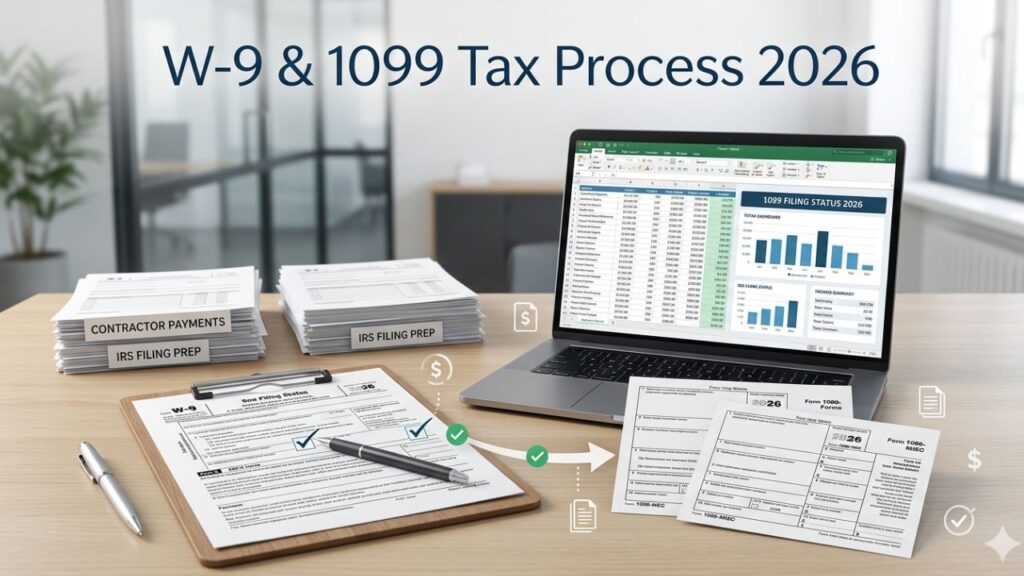
Step 1: Request a W9
Before paying a contractor, the business requests a completed W9 form.
Step 2: Verify Tax Information
The business reviews the taxpayer information, including SSN or EIN details.
Step 3: Track Contractor Payments
Throughout the year, the business records all payments made.
Step 4: Prepare the 1099 Form
At the end of the year, payment totals are used to prepare Form 1099-NEC or Form 1099-MISC.
Step 5: Submit Tax Forms
The forms are then sent to both the contractor and the IRS.
When to Request or Issue a W-9 and 1099
Timing matters when handling contractor tax paperwork.
Before Sending Payments
Businesses should always request a W9 before making the first payment.
Waiting until tax season often creates unnecessary problems.
During the Working Relationship
Companies should maintain updated contractor records throughout the year.
This helps avoid missing information later.
During Tax Season
1099 forms are generally prepared after year-end payment totals are finalized.
Businesses then distribute forms before IRS filing deadlines.
Why Early Preparation Helps
Early organization reduces:
- Filing stress
- Missing taxpayer details
- Incorrect reporting
- IRS compliance risks
- Payment disputes
Important Considerations for Independent Contractors
Independent contractors have tax responsibilities that differ from traditional employees.
Understanding these responsibilities can help freelancers avoid tax surprises.
Keep Financial Records Organized
Contractors should maintain:
- Payment invoices
- Expense receipts
- Tax documents
- Business bank records
- Accounting reports
Understand Self-Employment Taxes
Unlike employees, freelancers are responsible for self-employment taxes.
This includes Social Security and Medicare taxes.
Prepare for Quarterly Taxes
Many contractors must make estimated quarterly tax payments throughout the year.
Failing to do so can result in IRS penalties.
Double-Check W9 Information
Incorrect taxpayer information can delay payments or trigger backup withholding.
Does a 1099 Require a W2?
One of the most common tax questions involves understanding the difference between a 1099 and a W2.
The short answer is no — a 1099 does not require a W2.
These forms apply to different worker classifications.
What Is a W2?
A W2 form is used for employees.
Employers withhold payroll taxes from employee wages and report earnings using Form W2.
What Is a 1099?
A 1099 is used for independent contractors.
Contractors manage their own taxes rather than receiving payroll tax withholding.
Employee vs Contractor Classification
The IRS uses several factors to determine worker classification, including:
- Work control
- Financial independence
- Relationship structure
- Payment arrangements
- Business integration
Why Classification Matters
Incorrect classification can result in:
- IRS audits
- Back taxes
- Penalties
- Legal disputes
- Payroll compliance issues
IRS Tax Deadlines for Forms W-9, 1099-NEC, and 1099-MISC
Meeting tax deadlines is critical for businesses and freelancers.
Missing deadlines can result in penalties and unnecessary compliance issues.
Common 1099 Filing Deadlines
Businesses generally provide 1099-NEC forms to contractors by the end of January.
IRS filing deadlines may vary slightly depending on electronic or paper filing methods.
Why W9 Collection Should Happen Early
Since businesses need W9 information to prepare tax forms, collecting the form early prevents filing delays.
Electronic Filing vs Paper Filing
Electronic filing is becoming increasingly common because it:
- Reduces errors
- Speeds up processing
- Improves recordkeeping
- Simplifies corrections
Importance of Staying Updated
IRS filing requirements may change over time, so businesses should review updated tax guidance each year.
Penalties for Forms W-9 or 1099 Mistakes
Tax reporting mistakes can become expensive very quickly.
The IRS may impose penalties for inaccurate or late forms.
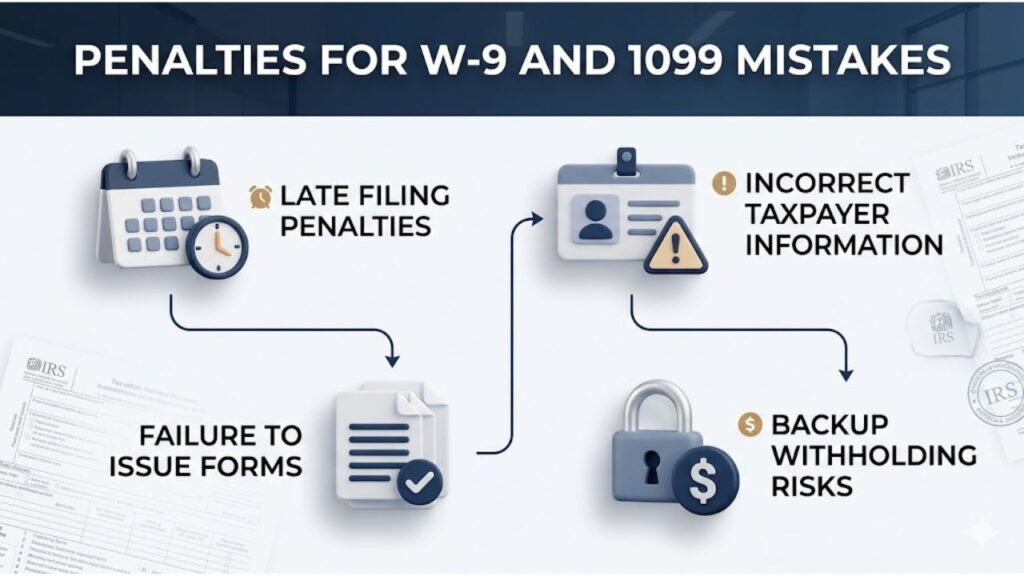
Late Filing Penalties
Businesses that miss filing deadlines may face increasing penalties based on how late the forms are submitted.
Incorrect Taxpayer Information
Wrong SSN or EIN information can trigger reporting errors and IRS notices.
Failure to Issue Forms
Failing to provide contractors with required 1099 forms can result in compliance problems.
Backup Withholding Risks
If a contractor refuses to provide a valid W9, businesses may need to apply backup withholding rules.
Why Accurate Recordkeeping Matters
Maintaining organized records reduces:
- Reporting errors
- Compliance issues
- Tax disputes
- Filing delays
- Financial confusion
1099 Form vs W9 for Shopify and eCommerce Sellers
Online businesses frequently work with freelancers, agencies, and service providers.
Because of this, understanding contractor tax reporting is extremely important for eCommerce sellers.
Common Contractors Used by Online Sellers
Shopify and eCommerce businesses often hire:
- Marketing specialists
- SEO writers
- Virtual assistants
- Product photographers
- Customer support teams
- Developers
- Advertising agencies
Why Tax Tracking Matters
As online businesses grow, managing payments manually becomes difficult.
Poor organization can lead to:
- Missing tax forms
- Incorrect reporting
- Expense tracking problems
- Accounting confusion
Importance of Bookkeeping Systems
Strong bookkeeping systems help businesses:
- Track contractor payments
- Organize expenses
- Prepare tax reports
- Improve financial visibility
- Reduce tax-season stress
How PlugBooks Helps Businesses Manage Tax Forms
Managing contractor payments and tax reporting manually can become overwhelming for growing businesses.
PlugBooks helps eCommerce sellers organize financial records, automate bookkeeping workflows, and simplify tax preparation.
Benefits of Using PlugBooks
Automated Bookkeeping
Sync sales channels and accounting platforms more efficiently.
Better Financial Organization
Track payouts, contractor expenses, and operational costs in one place.
Simplified Tax Preparation
Well-organized records make year-end tax filing easier.
Improved Reporting Accuracy
Reduce bookkeeping mistakes and improve financial visibility.
For Shopify, Amazon, and eBay sellers, organized accounting systems can make tax season significantly less stressful.

FAQs
Is a W9 the same as a 1099 form?
No. A W9 collects taxpayer information, while a 1099 reports contractor income to the IRS.
Do freelancers need both forms?
Freelancers often complete a W9 and later receive a 1099 from businesses that paid them.
Can a contractor receive both a W2 and 1099?
Yes. Someone can work as an employee for one company and an independent contractor for another.
What happens if a contractor does not submit a W9?
The business may need to apply backup withholding rules and could face reporting complications.
Who files a 1099-NEC?
Businesses that pay qualifying independent contractors generally issue Form 1099-NEC.
Are digital payment apps included in 1099 reporting?
Certain payment processors may issue separate tax reporting forms depending on transaction activity and IRS requirements.
Quick Recap
- A W9 collects contractor tax details
- A 1099 reports contractor income
- Businesses use both forms together for compliance
- Accurate bookkeeping reduces tax errors
- Contractors should maintain organized records
- IRS deadlines and penalties are important for businesses
Conclusion
Understanding the difference between a 1099 form vs W9 helps businesses and freelancers manage taxes more accurately in 2026. A W9 collects contractor tax details, while a 1099 reports payments made during the year. Using both forms correctly can reduce IRS errors, improve bookkeeping, and make tax season easier for eCommerce sellers and growing businesses.
