




Running a Shopify store without consistent financial reporting in 2025–26 is like navigating blind. You may see orders come in, but without clear, structured financial insights, it’s difficult to know if your store is truly profitable.
Implementing a consistent financial reporting framework ensures your Shopify store’s data is accurate, up-to-date, and easy to analyze, helping you make smarter decisions and scale faster. Whether you manage a few products or a large Shopify operation, maintaining structured and consistent financial reports helps track performance, identify trends, and stay compliant with accounting standards in 2025–26.
Key Points
1. Reliable Insights: Accurate and consistent reports give you the data you need to make smart business decisions.
2. Profit Visibility: Easily track which products, categories, or campaigns drive the most profit.
3. Error Minimization: Standardized reporting reduces mistakes and prevents costly accounting errors.
4. Compliance Ready: Stay fully prepared for taxes, audits, and regulatory requirements.
5. Trust & Credibility: Transparent financial reporting boosts confidence with investors, partners, and stakeholders.
What Are Consistent Financial Reporting?
Consistent financial reporting means preparing financial statements and reports using the same processes, formats, and schedules every time. For Shopify sellers, this approach has important implications:
- Accurate Record-Keeping: Track all sales, expenses, and refunds precisely.
- Standardized Templates: Use the same formats for balance sheets, income statements, and cash flow statements.
- Regular Reporting: Generate reports on a consistent schedule—weekly, monthly, or quarterly.
- Compliance & Accuracy: Follow accounting standards to ensure your data is accurate, reliable, and comparable over time.
By maintaining consistent financial reporting, Shopify store owners can easily monitor store performance, forecast revenue, and make informed decisions to grow their business in 2025–26.

Understanding Types of Financial Reports on Shopify
Types of financial reports are quite important for Shopify sellers to be successful. This is what you need to know:
- The income statement shows how much money your Shopify store made, spent, and made in net profit over a certain time period. This lets you figure out how much money your store makes.
- Balance Sheet: Shows you what your assets, debts, and equity are worth at a certain point in time. Good for figuring out how healthy your finances are generally.
- The Cash Flow Statement shows how money comes in and goes out of your Shopify store. It is important to make sure you can pay your bills and put money back into your firm.
- Statement of Shareholder Equity: If your Shopify store has more than one owner, this indicates how ownership equity has changed, including retained earnings.
You can also refer to a financial report sample for Shopify stores to understand how these statements are structured and customized for ecommerce.
For more detailed insights, check out Shopify Reporting with PlugBooks and Report Shopify Store.
Real Shopify Seller Experience
Sarah is a Shopify seller who owns a modest store that sells handmade jewelry. At first, it was hard for her to figure out which products were really making money because her reports weren’t always clear. Sarah was able to do the following after she started doing regular Cash flow report and using PlugBooks Ecommerce Reporting:
- Keep an accurate record of your monthly income and expenses
- Find out what sells well and get rid of stuff that isn’t making money.
- Automate making reports to save hours every week.
Because of this, Sarah not only made more money, but she also felt more sure about her business choices.

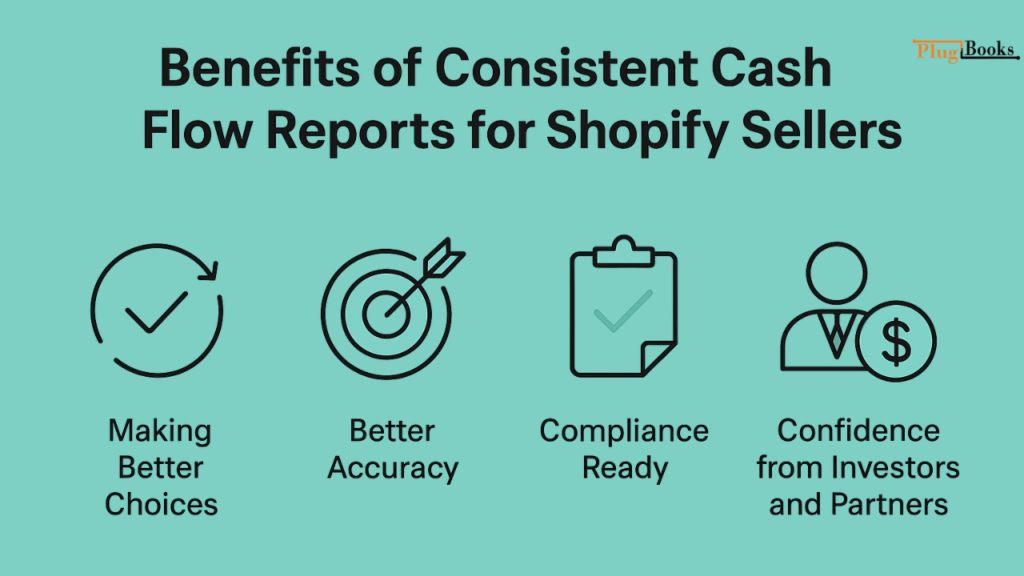
Benefits of Consistent Cash flow report for Shopify Sellers
There are many benefits to using consistent Cash flow report in Shopify:
- Making Better Choices: Clear reports make it easy to find your best-selling items, your most profitable categories, and your slow-moving stock.
- Better Accuracy: Standardized reporting makes Shopify’s sales and financial data less likely to be wrong.
- Compliance Ready: Regular reports make sure your Shopify store is ready for taxes and audits.
- Confidence from Investors and Partners: Clear Business report help investors, partners, and lenders trust you.
You can also explore integrations like Amazon and Shopify Integration to consolidate orders and reporting across platforms.
Shopify Accounting report Developments to Watch
Shopify businesses can stay competitive by keeping up with changes in ecommerce accounting reports. Some of the things that are happening right now are:
- Automated Shopify accounting connections, such as QuickBooks or PlugBooks
- Dashboards for sales, inventory, and cash flow on Shopify in real time
- AI-powered information for predicting costs and income
For Shopify sellers using payment solutions like Klarna, Klarna Shopify Integration can help track transactions consistently.
Steps to Achieve Consistent Financial Overview on Shopify
- Use Standardized Templates: Keep all Shopify Financial overview in a consistent format.
- Schedule Regular Reporting: Weekly or monthly reporting ensures you track store performance effectively.
- Automate Where Possible: Connect Shopify with tools like PlugBooks Shopify Bookkeeping to automate income, expense, and cash flow tracking.
- Stay Updated: Follow Financial overview developments to optimize your reporting process for Shopify growth.
You can also calculate profitability with Shopify Calculator for accurate financial insights.

FAQs
Q1: How often should Shopify sellers generate Profit and loss report?
A1: Ideally, Shopify sellers should generate monthly reports, but weekly summaries for sales and cash flow can help make quicker decisions.
Q2: Can I automate consistent Profit and loss report for my Shopify store?
A2: Yes! Tools like PlugBooks can automate reporting, sync sales across platforms, and reduce manual errors.
Q3: What is the most important report for Shopify sellers?
A3: While all reports are important, the income statement and cash flow statement are critical for tracking profitability and liquidity.
Q4: Do consistent company reports help with taxes?
A4: Absolutely. Regular, standardized reports ensure you have accurate records for tax filings and audits.
Q5: How do I start implementing a consistent Company report?
A5: Begin by standardizing templates, scheduling regular reporting, and using automation tools to simplify the process.
Final thoughts
For Shopify sellers, a regular accounting report is very important for long-term success. You can make smart choices, stay in compliance, and grow your Shopify business with confidence by knowing about several sorts of accounting reports, such as the income statement, balance sheet, cash flow statement, and statement of shareholder equity, and using tools like PlugBooks.