




Deferred revenue is one of the most important accounting concepts for businesses that receive payments in advance. It plays a critical role in accurate financial reporting, ensuring your books reflect real performance rather than just cash flow.
Understanding what is deferred revenue helps you stay compliant with accounting standards and plan better for future income. You’ll see this concept used frequently in SaaS, subscription services, insurance, and eCommerce businesses.
Key Takeaways:
- Deferred income is also called unearned revenue.
- It affects the balance sheet, not the income statement, until earned.
- It improves forecasting and compliance.
- It is common in advance billing and subscription models.
- Proper recognition avoids legal and financial risk.
1. What Is Deferred Revenue?
The term deferred income refers to money a business receives before delivering goods or services. Since the service or product is not yet delivered, the amount is not considered earned and is recorded as a liability on the balance sheet.
This ensures that revenue is only recognized once it’s earned, following established accounting principles like ASC 606.
Example:
If a company receives $1,200 for a 12-month subscription, it can only recognize $100 each month as revenue while the remaining amount stays as Deferred income.
2. Deferred Revenue Meaning & Definition
Revenue deferrals definition: It is an obligation a company owes to customers after receiving payment in advance. This liability reflects services or products the company must still deliver.
Unlike earned revenue, Advance revenue does not immediately impact profit. It’s recognized over time, aligning revenue recognition with delivery of value.
Common Use Cases:
- Software subscriptions
- Annual maintenance contracts
- Prepaid insurance plans
- eCommerce pre-orders
3. Deferred Revenue vs Accrued Revenue
| Feature | Deferred Revenue | Accrued Revenue |
| Definition | Cash received before service delivery | Service delivered before cash is received |
| Balance Sheet Category | Liability | Asset |
| Recognition Timing | After service/product is delivered | Before cash is collected |
| Example | Prepaid subscription | Billed but not yet received income |
Key Insight: Revenue deferrals is about future performance obligations, while accrued revenue is about receivables for past service.
4. Real Examples of Advance revenue
- A gym charges an annual membership fee upfront.
- A software company collects yearly subscription payments.
- An insurance company receives premiums before coverage starts.
- An eCommerce store takes pre-orders for an upcoming product.
- A training company sells online courses in advance.
These examples show why Advance revenue is common in businesses that depend on advance billing or long-term contracts.
5. Deferred Revenue in Accounting
Unearned revenue impacts the balance sheet as a current liability.
When the business fulfills its obligation, the amount is moved from liability to earned revenue in the income statement.
This process ensures compliance with revenue recognition principles, protecting businesses from misstating earnings or overstating cash flow.
6. Journal Entry for Advance Revenue
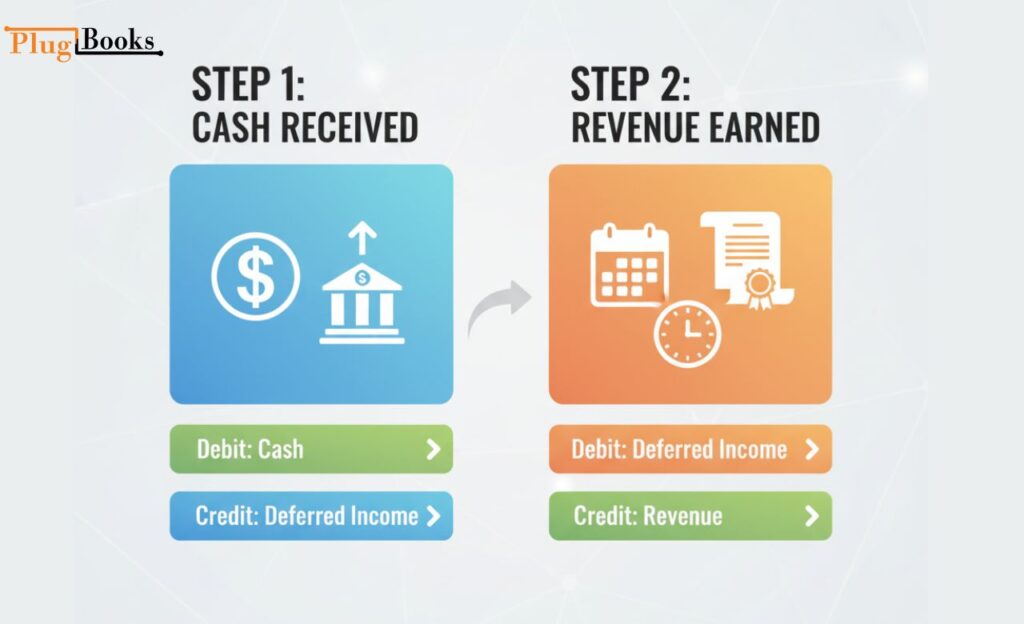
The Unearned revenue journal entry process includes two steps:
- When cash is received:
- Debit: Cash
- Credit: Deferred income (Liability)
- Debit: Cash
- When revenue is earned:
- Debit: Deferred income
- Credit: Revenue (Income)
- Debit: Deferred income
Example:
A company receives $12,000 for a one-year contract.
- At the start:
- Dr. Cash $12,000
- Cr. Customer prepayments $12,000
- Dr. Cash $12,000
- After one month:
- Dr. Deferred Revenue $1,000
- Cr. Revenue $1,000
- Dr. Deferred Revenue $1,000
This step-by-step recognition keeps financial statements accurate.
7. Revenue on the Balance Sheet
It remains under current liabilities because it represents a service or product yet to be delivered. If the delivery is more than a year away, it can be classified as a non-current liability.
This classification affects:
- Working capital calculations
- Cash flow forecasting
- Debt-to-equity ratios
- Investor confidence
8. Revenue Recognition Rules
Under ASC 606, companies must follow these five steps:
- Identify the contract.
- Determine performance obligations.
- Determine transaction price.
- Allocate price to obligations.
- Recognize revenue when obligations are met.
This framework ensures fair and transparent financial reporting.
9. Tax Implications of Deferred Revenue
- It is not taxable until earned.
- Businesses must align tax reporting with accounting recognition.
- Incorrect classification can trigger penalties or audits.
- Some industries have specific reporting timelines for deferred income.
Always consult a tax professional to comply with local laws.
10. SaaS and eCommerce: Why Deferred Revenue Matters
For SaaS and subscription businesses, deferred revenue represents future stability. It shows committed income and helps forecast future cash flow.
For eCommerce, it ensures pre-order or prepaid revenue isn’t overstated in current earnings. This makes financial reports more reliable for investors and stakeholders.
11. Managing Deferred Revenue Effectively
- Keep accurate records of advance payments.
- Match revenue recognition with delivery timelines.
- Use accounting software to automate tracking.
- Avoid manual misclassification.
- Review balances monthly for accuracy.
Automation reduces errors and strengthens financial control.
12. How PlugBooks Helps Automate Deferred Income
PlugBooks simplifies Prepaid income accounting for businesses of all sizes. It allows seamless:
- Automatic tracking of advance payments.
- Accurate journal entries aligned with revenue recognition.
- Integration with Shopify, Amazon, and other platforms.
- Real-time reporting for better decision-making.
- Compliance with accounting standards without extra manual work.
With PlugBooks, you can automate revenue recognition, save time, and maintain clean books effortlessly.

13. FAQs on Unearned Revenue
Q1: What is unearned revenue in simple terms?
It’s an advance payment a company receives before delivering products or services.
Q2: Is deferred income an asset or liability?
It’s a liability because the company still owes a service or product to the customer.
Q3: How do you record unearned revenue in accounting?
By crediting unearned revenue and debiting cash at the time of payment, then reversing the entry as the income is earned.
Q4: How long can income be deferred?
Until the company fully delivers the promised service or product.
Q5: Why is deferred income important?
It ensures transparency, compliance with accounting standards, and accurate financial forecasting.

14. Conclusion
Deferred income isn’t just an accounting term — it’s a financial truth that ensures earnings align with delivery. By understanding its meaning, definition, and journal entry process, you can maintain transparent, compliant financial statements.
And with PlugBooks handling automation, you can focus on growing your business, not chasing journal entries.