



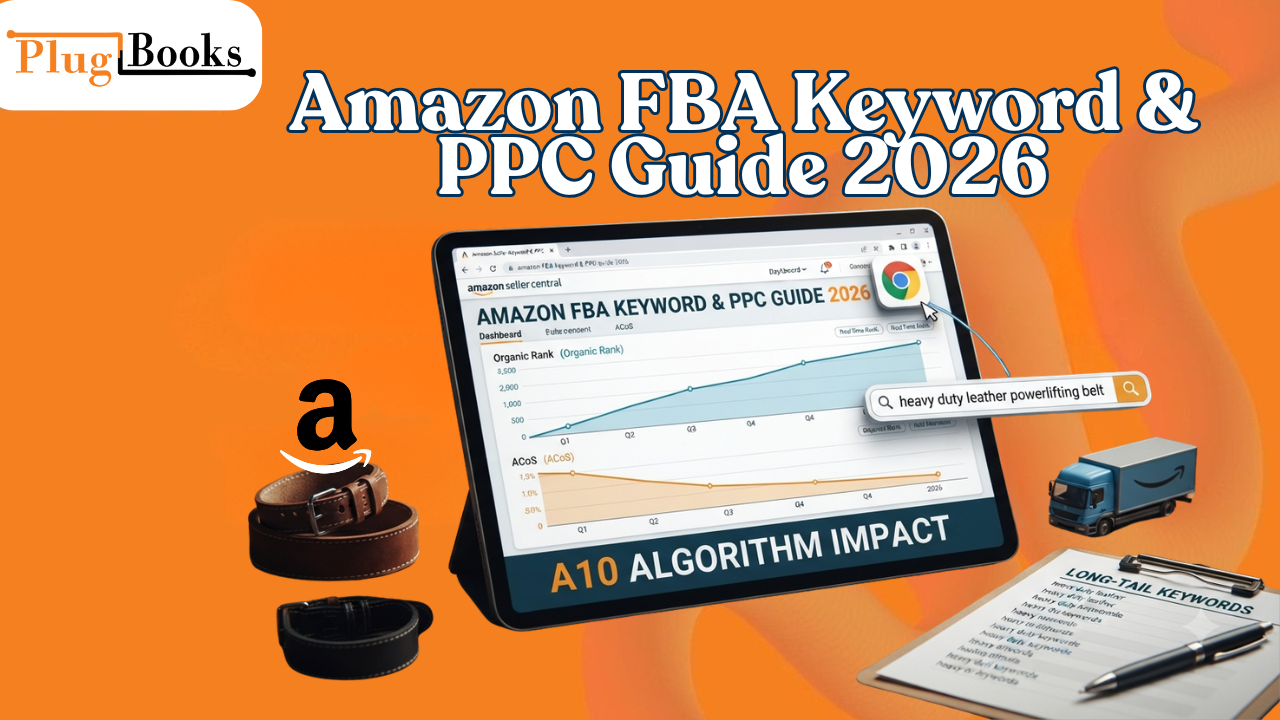
The Amazon A10 algorithm has completely redefined how products rank. Gone are the days when stuffing your listing and PPC campaigns with high-volume, generic keywords guaranteed organic dominance. Today, rising CPCs (Cost-Per-Click) and fierce competition mean that mastering your Amazon FBA keywords strategy is essential; otherwise, unoptimized ad spend and untargeted clicks will destroy your profit margins before your product ever gains traction.
To win on Amazon, you need a data-driven, closed-loop keyword strategy. Success relies on moving away from raw search volume and focusing instead on a precision-driven relevance loop: combining automated discovery, strict match types, advanced negative filtering, and airtight backend indexing.
1. The Anatomy of Modern Amazon Search Intent
Understanding what buyers type into the search bar is the foundation of any profitable advertising strategy. In 2026, treating all search terms equally is a recipe for wasted budget.
Navigational, Informational, and Transactional Intent
- Informational & Navigational Queries: These are broad terms where a user is researching a problem or looking for a specific brand (e.g., “how to stay hydrated” or “brand x water bottle”). While they have high search volume, they feature notoriously low conversion rates for product listings.
- Transactional Queries: These signal immediate buying intent. A user searching for a “stainless steel insulated water bottle with straw” knows what they want and has their credit card ready. Your budget should heavily favor these high-intent terms.
From Seed to High-Converting Long-Tail: A Practical Example
Understanding how to expand your keywords semantically separates amateur sellers from professionals. If you are launching a fitness accessory, you do not want to blow your budget trying to rank for the broad seed term “lifting belt”.
- The Broad Seed: “lifting belt” (High volume, hyper-competitive, low initial conversion for a new brand).
- The Mid-Funnel Modifier: “leather weightlifting belt for men” (Better context, moderate competition).
- The High-Intent Long-Tail: “heavy duty leather powerlifting belt with lever buckle” (Low volume, but laser-focused buyer intent, high conversion rate, and much lower CPC).
By targeting these specific, multi-word semantic variations, you capture buyers who are past the research phase and ready to check out, instantly boosting your keyword relevance score in Amazon’s eyes.
Relevance Over Raw Volume
Targeting a keyword with 50,000 monthly searches might look impressive on a spreadsheet, but if your product doesn’t perfectly match the exact buyer intent, your click-through rate (CTR) and conversion rate will plummet. Amazon’s algorithm continuously monitors your conversion rate per keyword. If you rank for a term but fail to convert, Amazon will swiftly drop your organic and sponsored ranking for that term. Prioritize contextual relevance over raw volume every single time.
2. Step-by-Step Amazon FBA Keyword Generation Framework
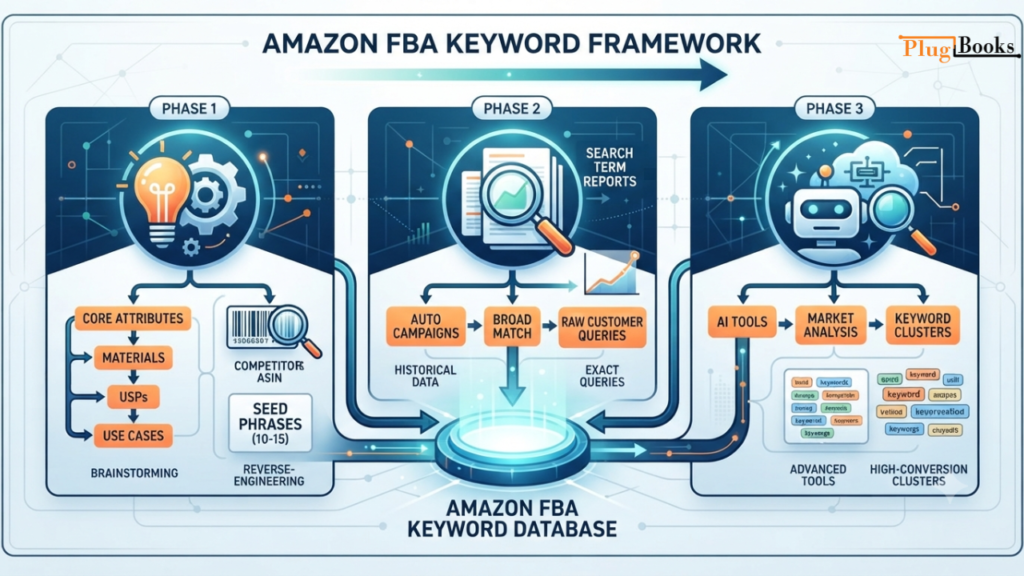
Building a robust Amazon FBA keyword database requires a multi-phase approach. Start by utilizing an Amazon FBA keyword tool Chrome extension to instantly extract high-volume competitor search terms directly from product pages, then blend this data with automated extraction.
- Phase 1: Manual Brainstorming & Competitor Reverse-Engineering: Begin by mapping out your product’s core attributes, materials, unique selling propositions (USPs), and primary use cases. Aim for an initial list of 10 to 15 core seed phrases. Next, reverse-engineer your top competitors using ASIN analysis tools to see which keywords are driving their organic and paid traffic.
- Phase 2: Leveraging Amazon Search Term Reports: The single most accurate source of keyword data is your own historical data. Dive into your Search Term Reports from existing automatic and broad match campaigns. These reports show you the exact, raw queries real shoppers typed into Amazon to find your product—including long-tail variations you would never have thought of manually.
- Phase 3: AI-Powered & Advanced Tools: Scale up your keyword list by integrating modern AI-driven keyword generators and market-analysis platforms. These tools analyze current A9/A10 algorithm patterns to transform basic product descriptions and categories into structured, high-conversion keyword clusters.
3. Mastering Amazon Match Types: Broad, Phrase, and Exact
Match types give you control over your ad reach. Think of them as a funnel designed to take you from initial discovery down to high-conversion scaling.
| Match Type | Reach & Control | Best Use Scenario |
| Broad Match | Widest reach, initial control | Discovery and testing. Casts a wide net to find new, untapped search queries. |
| Phrase Match | Moderate reach, control | Captures specific modifier sequences and mid-funnel intent while keeping context intact. |
| Exact Match | Most precise reach, control | Protects your top-performing revenue drivers and scales profitable sales. |
The Progression Strategy
Start your campaigns on broad matches to harvest fresh data and discover hidden search terms. Once you identify search queries that consistently generate sales at a healthy ACoS, “promote” those terms out of discovery and into your exact match campaigns to maximize your return on ad spend.
4. Advanced Campaign Architecture: The Waterfall Strategy
One of the most common mistakes sellers make is allowing their own ad groups to compete against each other—a phenomenon known as keyword cannibalization. When multiple campaigns target the same keywords, you end up bidding against yourself and artificially inflating your CPC.
Top-performing sellers solve this by implementing a Waterfall Match-Type Structure with cross-negative architecture:
- Broad Match Campaign (Discovery): Acts as your research net. Action: Add your Phrase and Exact match target keywords as Negative Phrase and Negative Exact here to force Amazon to push traffic down the correct funnel.
- Phrase Match Campaign (Validation): Tests modifier combinations and commercial intent. Action: Add your Exact match target keywords as Negative Exact here.
- Exact Match Campaign (Performance): Houses your proven, high-converting revenue drivers. Action: No internal match-type negatives needed, aside from universal waste terms.
5. Streamlining Financial Tracking Beyond PPC
While mastering keyword targeting and lowering your ACoS will successfully drive revenue, scaling an Amazon business quickly introduces a massive backend operational challenge: financial reconciliation. Tracking multi-channel fees, inventory costs, and automated tax reporting manually is nearly impossible as order volume grows.
This is why successful sellers integrate automated bookkeeping platforms like Plugbooks.io right alongside their PPC workflows. By synchronizing your Amazon seller account data directly with your financial ledger, you ensure that every dollar saved through precise keyword optimization is accurately tracked, giving you a crystal-clear picture of your true net profit in real time.
6. Backend Optimization and Indexing Rules
Finding keywords is only half the battle. Proper backend and frontend placement determines whether Amazon indexes your product organically.
- The 249-Byte Limit: Amazon strictly enforces a limit of 249 bytes for the backend Generic Keywords field. Exceeding this limit can cause the entire field to be ignored by the algorithm. Note that special characters and accented letters can consume more than one byte per character.
- No Repetition: Never repeat words in your backend search terms if they are already present in your Title, Bullet Points, or Description. Amazon’s index already crawls your frontend text; repeating words wastes precious backend space.
- Singular vs. Plural: You do not need to include both singular and plural forms (e.g., “bottle” and “bottles”) in the backend. Amazon’s algorithm automatically handles basic plurals and close linguistic variations for indexing purposes.
7. The Weekly Audit Routine & Seasonality
Keyword research is never a “set-and-forget” task. To protect your account from declining conversion rates and rising advertising costs, execute a strict audit routine every 7 days:
- Harvest Search Terms: Pull your Search Term Report from automatic and broad discovery campaigns. Filter for queries that have driven two or more conversions within an acceptable ACoS threshold.
- Promote Winners: Immediately move these validated search terms into your Phrase or Exact match performance campaigns.
- Bleed the Losers: Filter for terms that have accumulated a high click count (typically 15 to 20+ clicks) with zero conversions. Add these immediately as Negative Exact to stop the financial drain. Keep in mind that negative keywords require up to 72 hours to fully propagate across Amazon’s live ad network.

Adapting to Seasonality and 2026 Trend Shifts
Consumer search behavior is never static. What converts in January (such as fitness gear and organization items) looks entirely different from what drives sales in Q4 (holiday gifting and electronics).
- Quarterly Keyword Refreshes: Do not rely on the same keyword list year-round. Every quarter, audit your historical data for emerging seasonal search trends. For instance, a summer query like “insulated beach cooler” needs to shift toward “tailgate cooler bag” by autumn.
- Dynamic Negatives for Seasons: Seasonality also affects negative keywords. A search term that is irrelevant in July might become a high-converting product variant in December. Ensure your negative exact lists are reviewed quarterly so you do not accidentally block newly trending, profitable variations.
Final Takeaway
Sustained Amazon profitability in 2026 requires treating your keyword strategy as a continuous, closed-loop cycle: Research, Test via Broad match, Refine through structured Match Types, and Exclude waste using Negatives.
However, remember that frontend advertising and backend accounting must work in harmony. Relying on fragmented spreadsheets for your P&L statements leaves too much room for costly human error. Modern Amazon operators automate this back-office burden by connecting tools like Plugbooks.io to seamlessly handle transaction matching, data syncing, and financial compliance.
When your advertising metrics and your accounting data work together seamlessly, you eliminate guesswork, lower your ACoS, protect your profit margins, and position your brand for sustainable, stress-free growth.

Frequently Asked Questions (FAQs)
1. How does the Amazon A10 algorithm impact your Amazon FBA keyword rankings?
It ranks products based on organic conversion velocity and customer behavior rather than keyword density. Failing to convert traffic for a target query results in a drop in algorithmic visibility.
2. How do I construct high-intent long-tail keyword variations?
Layer specific attributes onto base terms. Progress from a head term like “lifting belt” to a modifier like “leather weightlifting belt for men”, ending with a conversion-focused phrase like “heavy duty leather powerlifting belt with lever buckle”.
3. What is the Waterfall Match-Type Strategy?
A structured ad architecture separating Broad, Phrase, and Exact match campaigns. Applying cross-negatives stops keyword cannibalization and keeps individual ad groups from bidding against each other.
4. What are the core rules for backend search terms?
Amazon enforces a strict 249-byte limit. Omit words already present in your title or bullet points, and skip singular/plural duplicates since the system handles indexing variations automatically.
5. What steps are involved in a weekly keyword audit?
Analyze Search Term Reports every 7 days. Move search terms with $\ge 2$ conversions into exact match performance campaigns, and designate queries with 15+ clicks and zero sales as Negative Exact.
6. Why is automated bookkeeping necessary for growing brands?
Manual spreadsheet tracking for multi-channel fees and inventory costs leads to errors. Solutions like Plugbooks.io automate ledger updates and transaction matching to provide clear net profit insights.
7. How do quarterly trends affect keyword targeting?
Buyer search habits shift across seasons (e.g., Q1 fitness resolutions vs. Q4 holiday shopping). Perform quarterly keyword updates and audit negative lists to prevent blocking newly rising seasonal queries.
8. How do back-office financial tools connect with PPC data?
Platforms like Plugbooks.io sync backend sales and tax data directly alongside advertising metrics, ensuring real-time financial clarity across your entire storefront operation.

Disclaimer
This guide is for educational purposes only and does not guarantee sales or rankings. Amazon advertising carries financial risk; we disclaim liability for any losses.