




If you are selling on Amazon in 2026, proper Amazon seller accounting and bookkeeping is no longer optional — it’s survival.
Rising FBA fees, storage charges, advertising costs, and tax regulations make accounting for Amazon sellers more complex than ever. Many sellers think high sales mean high profit — but without structured accounting Amazon systems, hidden costs quietly eat margins.
Whether you’re doing private label, wholesale, or dropshipping, mastering Amazon FBA accounting ensures you know your real numbers.
Key Takeaways
- Amazon settlement reports must be reconciled regularly
- FBA fees directly impact net profit
- Inventory accounting determines real margins
- Automation reduces human error
- Clean books make scaling easier
Understanding Amazon Seller Accounting vs Bookkeeping
What is accounting for Amazon sellers?
The main things that Amazon seller accounting looks at are:
- Statements of profit and loss
- Sheets of balance
- Keeping track of cash flow
- Planning for taxes
- Predicting finances
It tells you: Are you really making money?
Strong accounting for Amazon merchants gives them more than just sales figures.
What is the bookkeeping for Amazon sellers?
Every day, bookkeeping means keeping track of:
- Deals made in sales
- Returns and refunds
- Money spent on ads
- Buying things for stock
Amazon FBA accounting isn’t reliable without good bookkeeping.
Accounting vs Bookkeeping – Key Difference
Keeping track of transactions is what bookkeeping is.
Accounting is figuring out how healthy your finances are.
You will need both of these things to keep track of your Amazon sales and books in 2026.

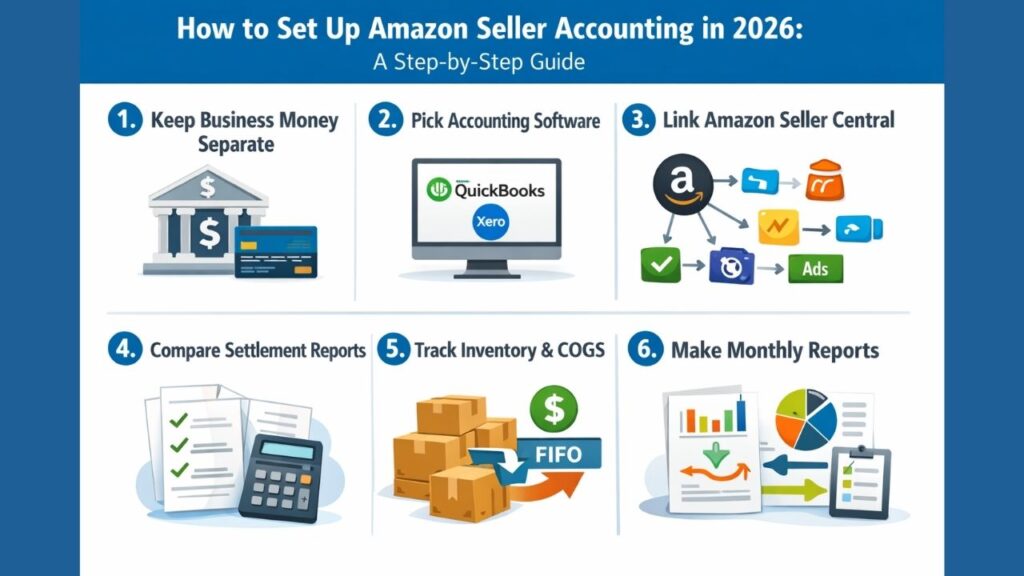
How to Set Up Amazon Seller Accounting in 2026: A Step-by-Step Guide
Step 1: Keep your business money separate
Open:
- Bank account for business
- Credit card for a specific purpose
When you mix your own money with Amazon’s, it messes up their accounting.
Step 2: Pick the Right Accounting Software.
Manual spreadsheets fail at scale.
Use:
- QuickBooks
- Xero
- Amazon integration tools
Professional software simplifies accounting for Amazon sellers.
Step 3: Link Amazon Seller Central
Sync:
- Orders
- Money back
- Costs of advertising
This automation is very important for keeping proper Amazon FBA records.
Step 4: Compare Amazon Settlement Reports
Amazon pays out every two weeks.
You have to:
- Match gross sales
- Take off fees
- Make changes to refunds
- Check deposits
Reconciliation is the most important part of Amazon seller accounting and bookkeeping.
Step 5: Keep track of your inventory and COGS correctly
Use FIFO method for:
- Cost of Goods Sold
- Landed cost calculation
- Storage fees allocation
Inventory mistakes destroy accurate accounting Amazon systems.
Step 6: Make monthly reports on your finances
Look over every month:
- Loss and Profit
- Flow of Cash
- Valuation of Inventory
This changes raw data into useful information for Amazon sellers.
Mistakes and fixes in Amazon seller accounting
Not reconciling settlement reports
Problem: The numbers don’t match the bank deposits.
Fix: Check every two weeks.
Not Paying Attention to Refunds and Chargebacks
Refunds lower the amount of money you really make.
Strong Amazon FBA accounting always makes changes to them.
Putting Amazon fees in the wrong category
For Amazon records to be clean, all referrals, FBA, storage, and PPC must be included in the right categories.
Bad Tracking of Inventory Costs
You can’t figure out your profits if you don’t keep track of landed costs.
Putting personal and business costs together
This puts Amazon sellers at risk of paying too much in taxes and keeping bad records.
Taxes and Compliance in 2026
Laws about sales tax and marketplace facilitators
Amazon charges sales tax in a lot of states, but you are still responsible for paying income tax.
How to Plan Your Taxes as an Amazon Seller
Accurate bookkeeping and accounting for Amazon sellers lowers the risk of audits and overpayments.

Why Having Clean Books Lowers Audit Risk
Good record-keeping makes sure that your Amazon FBA accounting can stand up to examination.
Security & Financial Control Tips
- Turn on 2FA in Seller Central
- Limit employee access
- Make a copy of your accounting data
- Look over the finances every month
- Keep an eye on strange transactions
Financial control makes Amazon’s long-term accounting more stable.
Why Automation Matters in 2026
Manual accounting leads to:
- Mistakes when entering data
- Fees that weren’t paid
- Reports that are late
Automation improves:
- Accuracy
- Time efficiency
- Real-time reporting
Automation is a key part of modern accounting for Amazon merchants.
How PlugBooks Simplifies Amazon Seller Accounting and Bookkeeping
PlugBooks was made just for those who sell things online.
It helps with:
- Integration with Amazon that happens automatically
- Breakdown of fees that is correct
- Dashboards in real time
- Sync QuickBooks and Xero
- Clear financial reporting
Automation is the key to getting accurate Amazon FBA accounting without having to do it all by hand.
PlugBooks assists people who sell:
- Save time
- Make more money
- Confidently scale

FAQs
1. How do Amazon settlement reports impact financial accuracy?
Amazon settlement reports include sales, refunds, FBA fees, advertising charges, and adjustments. If you don’t reconcile them properly, your revenue and bank deposits will never match, leading to inaccurate profit reporting.
2. Should Amazon sellers use cash or accrual accounting?
Cash accounting records income when money is received, while accrual records income when sales occur. Most serious sellers prefer accrual accounting because it gives a more accurate picture of inventory costs and real profitability.
3. How are Amazon advertising (PPC) expenses recorded in bookkeeping?
Amazon PPC expenses should be categorized separately under marketing or advertising expenses. Tracking them properly helps measure true product profitability after ad spend.
4. How do inventory write-offs affect Amazon seller profits?
Damaged, lost, or unsellable inventory must be recorded as write-offs. If not tracked, your books will show inflated profits and incorrect inventory valuation.
5. What financial reports should Amazon sellers review monthly?
Every seller should review:
- Profit & Loss Statement
- Cash Flow Statement
- Inventory Valuation Report
- Expense Breakdown Report
These reports provide clarity on margins, liquidity, and operational efficiency.
6. How can poor bookkeeping slow down Amazon business growth?
Without accurate numbers, sellers:
- Overestimate profits
- Reorder inventory incorrectly
- Miscalculate taxes
- Face cash flow shortages
Strong financial systems allow confident scaling.
7. When should an Amazon seller hire a professional accountant?
If monthly revenue crosses consistent growth levels, inventory becomes complex, or tax filings become overwhelming, hiring an accountant or using automated systems becomes a smart investment.
8. How does multi-channel selling complicate Amazon accounting?
Selling on platforms like Shopify or Walmart alongside Amazon requires consolidated financial reporting. Without proper integration, tracking total revenue and expenses becomes difficult.
A quick review
- Bookkeeping keeps track of transactions
- Accounting looks at profit
- Reconciliation makes sure everything is right.
- Keeping track of inventory affects profitability
- Automation leads to growth
Final Thoughts
In 2026, bookkeeping and accounting for Amazon sellers is no longer just a job; it’s a way to get ahead of the competition.
Profit leaks stay hidden for Amazon merchants who don’t have organized bookkeeping.
Growth is risky without the right accounting for Amazon FBA.
Scaling is a mess without well-organized accounting systems on Amazon.
Clean books = Clear earnings = Confident growth.
Your Amazon business will be dependable, successful, and able to grow if you take your metrics seriously.