



In 2026, e-commerce solutions are no longer optional—they are the backbone of every successful online business. From small startups to large enterprises, these tools help businesses streamline operations, improve customer experience, and increase profitability.
With the rapid growth of online shopping and multi-platform selling, managing orders, inventory, payments, and customer communication manually has become nearly impossible.The right e-commerce solution can save time, reduce errors, and provide insights that drive smarter business decisions.
Integrated solutions like PlugBooks help address these challenges by automating bookkeeping, tracking profits, and simplifying tax management. With such tools, businesses can focus on growth rather than manual administrative tasks, ensuring they stay competitive in a rapidly evolving market.
What Are E-commerce Solutions?
E-commerce solutions are platforms, tools, and services that help businesses sell products or services online while managing operations efficiently. They cover areas like website creation, payment processing, inventory management, customer engagement, marketing, and analytics.
Businesses of all sizes use these solutions to automate repetitive tasks, ensure accurate reporting, and improve the customer experience.
For example, PlugBooks integrates with multiple e-commerce platforms to automate bookkeeping, track profits, and provide financial insights—all in real time.

Types of Online Selling Platforms
| Type | Description | Example | Pros | Cons |
| Hosted Online Store Platforms | All-in-one systems managed by the provider. | Shopify | Easy to set up, fast deployment | Less customization |
| Self-Hosted Online Shop Frameworks | Businesses manage hosting, customization, and maintenance themselves. | WooCommerce | Highly flexible, customizable | Requires technical knowledge |
| Enterprise Digital Commerce Platforms | Designed for large-scale businesses with complex workflows. | Magento | Scalable, robust | High cost, technical expertise needed |
| Headless Commerce Architectures | Separate frontend and backend for flexibility and performance. | N/A | Fast, scalable, fully customizable | Complex to implement |
Best e-commerce Solutions in 2026
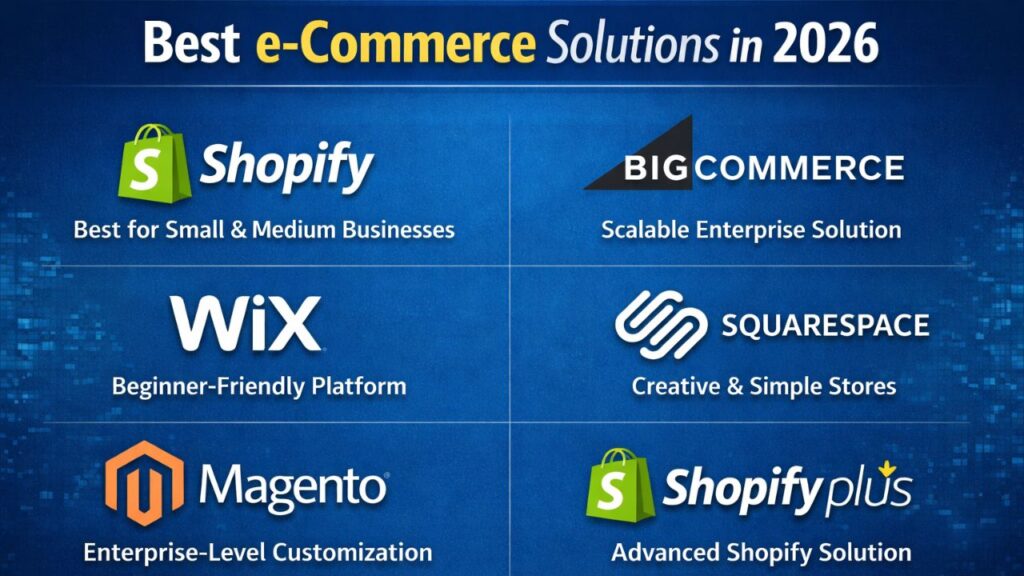
- Shopify – Best all-in-one solution for small and medium businesses. Offers app integrations and a simple interface.
- BigCommerce – Scalable enterprise solution with multi-channel selling features. Ideal for growing businesses.
- Wix – Beginner-friendly website builder with e-commerce features. Great for small businesses.
- Squarespace – Design-focused platform for creative brands. Simple store management and elegant templates.
- Magento – Enterprise-level platform with high customization and advanced capabilities. Best for tech-savvy teams.
- Shopify Plus – Advanced Shopify solution for high-volume sellers needing robust automation and reporting.
Benefits of Online Selling Platforms
Using online selling platforms brings numerous advantages to businesses operating online. They allow sellers to automate order processing, manage inventory efficiently, and gain insights from analytics. By streamlining operations, businesses can reduce errors and focus on growth.
These solutions also improve customer satisfaction by providing smooth checkout experiences and faster response times. Integrating financial tools like PlugBooks ensures accurate profit tracking and simplifies tax compliance.
Key Benefits
- 24/7 Selling Capability: Your store is always open, increasing revenue potential.
- Automation: Tasks like order processing, inventory updates, and email campaigns are automated.
- Global Reach: Sell to customers worldwide without physical store limitations.
- Data-Driven Decisions: Analytics help optimize pricing, marketing, and inventory.
- Cost Efficiency: Reduce overhead by minimizing manual operations.
How to Choose the Best e-commerce Solutions
- Budget: Choose a solution that fits your financial plan. Free vs premium.
- Ease of Use: Consider beginner-friendly vs advanced tools.
- Scalability: Ensure it can grow with your business.
- Integrations: Check for compatibility with payment, shipping, and accounting tools like PlugBooks.
- Security: Prioritize platforms with SSL, secure payments, and data protection.
- Customer Support: Reliable support ensures quick resolution of issues.
- Mobile Experience: Optimize for mobile shoppers to improve conversions.
Common Challenges & Solutions
| Challenge | Description | Solution |
| Managing Multiple Platforms | Sellers often sell on Shopify, Amazon, and eBay simultaneously. Without integration, tracking orders becomes complex. | Use integrated online selling platforms to centralize data and synchronize inventory. |
| Tracking Finances | Manual accounting can lead to mistakes and unclear profit margins. | Automate bookkeeping with PlugBooks for real-time profit tracking and accurate tax reports. |
| Inventory Issues | Stockouts or overselling can cause customer dissatisfaction. | Implement inventory management tools that sync across platforms. |
| Customer Retention | Getting repeat customers is challenging. | Use email marketing, loyalty programs, and CRM tools integrated with online store platforms. |
How PlugBooks Enhances Online Selling Platforms
Financial management is a critical aspect of e-commerce operations. PlugBooks helps sellers automate bookkeeping, track profits in real-time, and generate tax-ready reports. It integrates seamlessly with Shopify, Amazon, and eBay, making multi-platform management effortless.
With PlugBooks, sellers can focus on growing their business while staying financially organized and compliant.
Key Features
- Automated Bookkeeping: Sync stores data automatically without manual entry.
- Real-Time Profit Tracking: Know profits after fees, refunds, and expenses.
- Multi-Platform Integration: Works with Shopify, Amazon, and eBay simultaneously.
- Tax & Financial Reports: Generate accurate reports for decision-making.
- Error Reduction: Automation minimizes mistakes in financial data.

Role of Automation in ecommerce Solutions
Automation is essential for scaling e-commerce operations. Order processing, inventory updates, and customer communication can all be automated. Financial automation tools like PlugBooks allow sellers to monitor profits, track fees, and generate reports in real-time.
By reducing manual work, automation frees up time to focus on marketing, product development, and customer engagement.
FAQs
What are online selling platforms?
Tools and systems that help businesses sell products or services online while managing operations efficiently.
Which online commerce platform is best in 2026?
Shopify is recommended for most businesses due to its ease of use, scalability, and integration options.
Are online selling platforms expensive?
Costs vary—from free options for startups to premium solutions for large enterprises with advanced features.
Can beginners use online store platforms?
Yes, platforms like Wix and Squarespace are beginner-friendly and easy to set up.
Why is accounting important in digital commerce?
Accurate bookkeeping ensures correct profits, taxes, and financial data for informed business decisions.
How does PlugBooks help sellers?
PlugBooks automates bookkeeping, tracks profits in real time, and simplifies tax compliance for multiple platforms.
Can online commerce platforms handle multi-channel selling?
Yes, integrated systems and tools like PlugBooks manage multiple sales channels efficiently.
Are digital selling platforms safe?
Most platforms provide SSL, secure payment processing, and data protection to ensure safety.

Quick Recap
- ecommerce solutions streamline online selling and operations.
- Automation and analytics improve efficiency and growth.
- Choosing the right solution depends on budget, scalability, and integrations.
- PlugBooks enhances financial management and reduces errors.
Conclusion
In 2026, ecommerce solutions are essential for business success. They integrate automation, analytics, and financial management, helping sellers focus on growth rather than tedious tasks. Combining platforms like Shopify with PlugBooks ensures accurate profits, fewer errors, and smooth multi-platform management.
Integrating PlugBooks into your e-commerce solution is a smart way to save time, increase efficiency, and scale your business globally.