



Investing in the correct e-commerce accounting software can go a long way in helping you smoothly deal with sales, fees, refunds, taxes and marketplace rewards. Both A2X and PlugBooks aim to do away with the need for manual bookkeeping, but they take distinct approaches to e-commerce accounting.
Online sellers should evaluate their sales channels, order volume, accounting software, reconciliation requirements, and the degree of automation their firm needs to decide which is the preferable choice. Knowing the differences might help you pick a solution that matches your existing workflow and future growth.
What Is A2X?
A2X accounting is a cloud based accounting connector that is developed specifically to integrate e-commerce sales channels with general ledger accounting software such as QuickBooks Online and Xero. It doesn’t spit out individual line items for each order (which can quickly inflate accounting files), but rather lumps payouts together into neat monthly, weekly or daily journal entries. This strategy simplifies e-commerce sellers’ record keeping and makes reconciliation easier.
It’s a great platform for sellers with high volume transactions on big platforms like Amazon, Shopify, Walmart, and eBay. It automatically calculates marketplace fees, refunds and shipping withholdings and posts brief summary statements directly to your ledger. The accounting files are kept minimal, but revenue and expenses are also guaranteed to line up exactly with incoming bank deposits.
What Is PlugBooks and How Does It Work
PlugBooks is an automated bookkeeping solution that helps online merchants fill the gap between transaction activity from the marketplace and general ledger entries. As e-commerce enterprises scale, manual tracking of multi-channel sales involves high risks of human error.
The platform integrates directly with your sales channels and accounting systems to handle transaction synchronisation, sales reconciliation and tracking of marketplace fees. The technology establishes a direct funnel from sales data to your core ledger, removing laborious data entry and helping sellers stay organised for tax season and daily financial control.

A2X vs PlugBooks: Key Features Compared
Both services are designed to help you eliminate the manual work of documenting your e-commerce sales and reconciling your marketplace payouts, but the process of each can differ. It is very much centred around the conversion of marketplace settlement data to accounting-ready entries.
PlugBooks enables sellers to automate transaction syncing and bookkeeping throughout their e-commerce operations.
| Feature | A2X | PlugBooks |
| E-commerce accounting | Converts marketplace settlement data into accounting entries | Automates e-commerce transaction syncing and bookkeeping workflows |
| Supported sales channels | Amazon, Shopify, Walmart, eBay, and Etsy | Supports e-commerce sales channels and payment data |
| Accounting integrations | QuickBooks Online, Xero, Sage, and NetSuite | QuickBooks and Xero |
| Sales reconciliation | Settlement and payout-focused reconciliation | Transaction and payout reconciliation workflows |
| Fee tracking | Helps account for marketplace fees and deductions | Helps organize sales, fees, taxes, refunds, and settlements |
| Payout management | Designed to match settlement data with accounting records | Helps connect transaction activity with payout records |
| Historical data | Availability depends on the selected the solution plan | Depends on the account and connected data |
| Best suited for | Sellers and accountants who prefer structured settlement-based accounting | E-commerce businesses looking for automated bookkeeping across their sales activity |
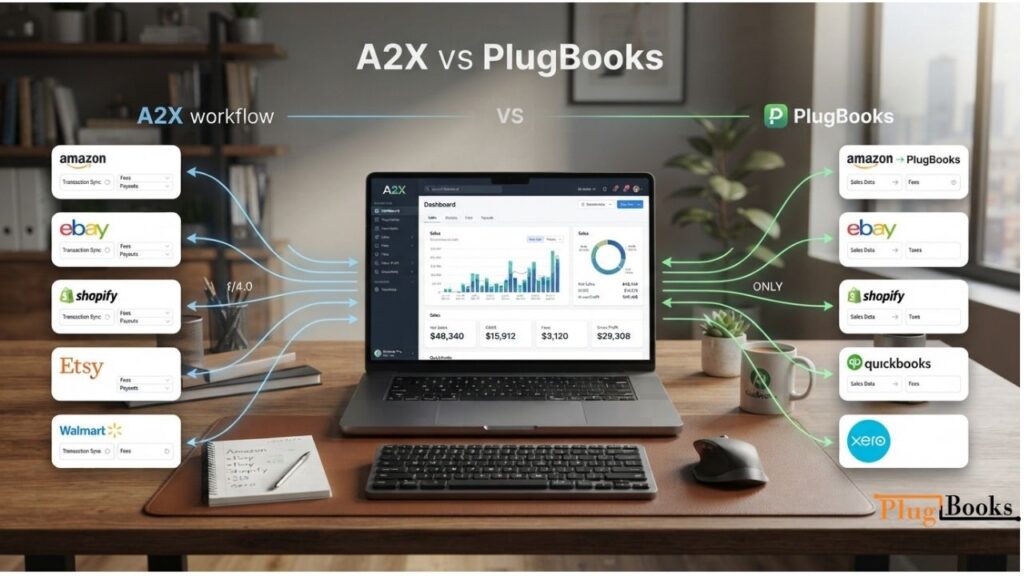
The software officially lists integrations with QuickBooks Online, Xero, Sage and NetSuite, while its supported e-commerce channels include Amazon, Shopify, Walmart, eBay and Etsy.
What is the best platform for Amazon sellers?
Before Amazon sellers receive a reward, they have to deal with sales, refunds, marketplace fees, fulfilment fees and other deductions. A2X is focused on taking that settlement data and translating it into consolidated accounting entries that can be reconciled with marketplace payouts and integrated with platforms like QuickBooks Online and Xero.
PlugBooks gives a more general approach to bookkeeping, helping to organise sales, fees, taxes, refunds and settlements while decreasing human transaction work.
It really comes down to your workflow. Sellers who want to report by payout may find a settlement-focused accounting solution is the right fit. Businesses looking for multi-channel automation and easier transaction administration would prefer a broader accountancy platform.
What About Sellers on Multiple Channels & Shopify?
More financial data is available to control when selling via Shopify, Amazon and other platforms. A2X integrates with a number of marketplaces and accounting platforms, whereas PlugBooks is built to automate e-commerce transaction data in the bookkeeping workflow.
Instead of just looking at integrations, look at how each platform deals with payouts, refunds, fees, taxes and reconciliation. This will enable you to decide which choice is most suitable for your organization.
Ease of Use: Which E-commerce Accounting Software is User-friendlier?
Accounting automation should save time, not add administrative work. First, connect your marketplace accounts to your QuickBooks or Xero chart of accounts. This ensures sales, fees, taxes, refunds, and payouts reach the right categories.
Once set up, the system runs with minimal intervention. However, basic accounting knowledge helps during the initial mapping process.
Meanwhile, PlugBooks offers a simple interface that lets you quickly sync transactions and clearly track how marketplace sales and fees flow into your general ledger.
Overall Price and Value
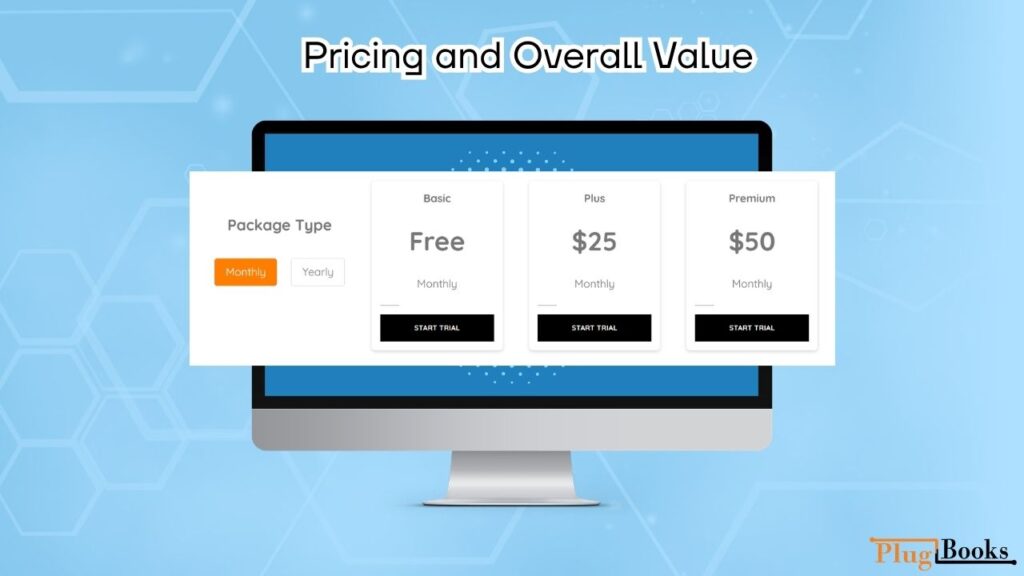
Instead of concentrating on the sticker price, estimate the financial investment of an automation platform by taking into account your transaction volume and operational workload. Both systems usually price based on monthly order volume or the number of sales channels connected.
One platform charges differently depending on how many orders it processes per month. For high-volume vendors, the expense may be worth it for the time saved in manual reconciliation, evaluation of transactions, and financial recordkeeping.
PlugBooks has competitive pricing models designed to support growing businesses with scalable options that increase with your monthly sales volumes. In terms of total value, think about how much staff or bookkeeping time you now spend chasing down missing fees or anomalies in payouts.
When to pick A2X?
If your business has unique operational demands, a specialised platform could be a good fit:
You do most of your work on Amazon or Shopify or Walmart and you get paid once in a while.
Your bookkeeper or accountant would rather see summarised journal entries than messy line-by-line transaction logs.
You have huge monthly order volumes and manual reconciliation is no longer feasible.
Use QuickBooks Online or Xero as your core general ledger, and wish to be deeply embedded in those ecosystems.
When is a bigger book-keeping platform the better choice?
A broader e-commerce bookkeeping solution makes a strong case for businesses seeking streamlined workflow automation:
- You want a streamlined approach to e-commerce bookkeeping automation that connects marketplace activity directly to your ledger.
- You manage a diverse mix of sales channels and payment gateways that require centralized transaction syncing.
- You prefer an intuitive platform setup that minimizes complex chart-of-accounts mapping.
- You are actively searching for an alternative that balances robust reconciliation with straightforward day-to-day usability.
PlugBooks: A Good Alternative?
The choice of a trustworthy alternative depends on the operational priorities of each vendor. If your present arrangement is struggling to cope with complicated payout matching or inflated transaction histories, it’s worth looking into alternative structural techniques.
When comparing choices, look closely at how each tool handles refunds, multi-currency transactions, gateway fees, and historical data imports. Testing out trial environments where available will give you a clearer picture of how well a platform integrates with your existing bookkeeping routine.

Final Word: Which eCommerce Accounting Software Is Best?
The choice between these two systems will depend on your business architecture, sales channels and accounting preferences. There isn’t a one-size-fits-all winner.
If you need clear, payout-based summaries for high-volume marketplaces, however, one option may suit you better. On the other hand, if you want broader e-commerce bookkeeping automation and multi-channel data management, the other may be a better fit. Before deciding, consider your order volume, team skills, and accounting needs.
Ready to streamline your financial workflows? Discover how PlugBooks may automate your e-commerce bookkeeping immediately.
Frequently Asked Question
What does A2X accomplish for e-commerce sellers?
A2X bridges e-commerce platforms and accounting systems, turning marketplace financial data into accounting-ready entries. It is especially helpful when organising sales, fees, refunds and settlement information, helping sellers balance marketplace payouts against their accounting records.
QuickBooks for automating e-commerce bookkeeping?
“Sure. Accounting automation software can connect your sales channels to QuickBooks and automate your e-commerce bookkeeping. The appropriate configuration will cut down on manual entry by pushing sales, fees, refunds and payout info into the accounting cycle.
What accounting software integrates effectively with Amazon seller data?
Popular choices for Amazon sellers include QuickBooks Online and Xero, while A2X also supports Sage and NetSuite. The right decision will rely on the accounting needs, reporting requirements and existing bookkeeping structure of the organization.
Can I use PlugBooks for different sales channels?
PlugBooks is meant to help e-commerce companies automate transaction data and bookkeeping operations for their online sales activities. If you sell through numerous channels, look at the connections currently supported and choose a setup that matches your markets and accounting systems.
What Sellers Should Compare Before Choosing Accounting Software For E-commerce?
Check supported sales channels, accounting connectors, reconciliation techniques, fee and refund handling, historical data, price, setup requirements and scalability. The optimal solution will be one that is suitable for your current transaction volume and the bookkeeping procedure you plan to have as your firm expands.
What’s the Best E-Commerce Accounting Software for Online Sellers?
There is no one-size-fits-all alternative. The best choice depends on your sales channels, accounting software, transaction volume, reconciliation needs, and preferred workflow.