



Amazon advertising can put your products in front of shoppers who are already looking for something you sell. That can be especially helpful when launching a new product, competing in a crowded category, or trying to increase sales.
But more sales do not always mean more profit.
Advertising spend is only one part of the picture. Amazon fees, product costs, fulfillment, refunds, shipping, and other expenses can all reduce what you actually keep from each sale.
Whether you’re new to Amazon PPC or already running several campaigns, understanding how advertising works and how it affects your margins can help you make better decisions about where to spend your budget.
What Is Amazon Advertising?
Amazon advertising is Amazon’s paid advertising strategy for pushing products and brands to shoppers. Ads can show up in search results, product detail pages and other Amazon shopping places depending on the campaign type.
For sellers, the most common goal is rather simple: acquire more eyeballs on the product and turn that into purchases.
The question is whether those increased sales are really benefiting the firm. A campaign can create a lot of orders, but after paying for advertising and other selling expenses, there might not be much profit left.
That is why advertising is best evaluated as part of the larger financial picture and not as an isolated marketing spend.
What Is Amazon PPC and How Does It Work?
Amazon PPC is pay per click advertising. In a traditional PPC campaign, you pay for clicks, not impressions.
PPC campaigns can be used to promote products and target buyers based on search terms, products, or other available targeting choices.
Say, for example, you’re selling insulated water bottles. You may construct a campaign around searches for insulated water bottles. That contact can lead to an advertising charge when a shopper clicks on your advertisement.
The price you pay varies on your campaign parameters, bids, competition, clicks, and other things. That’s why PPC prices can vary so much from seller to seller or product to product.
Why Is Amazon PPC Important for Sellers?
Amazon PPC allows retailers to get paid visibility as opposed to only relying on organic search results.
This can be effective if the product is new, there’s heavy competition, or you want to target buyers who are actively looking for products like yours.
Advantages of Amazon Advertising
- Improve product visibility
- Target appropriate purchase intent shoppers
- Support product rollouts
- Generate extra sales opportunities
- Test search phrases and targeting concepts
- Learn more about demand from shoppers
- Enhance product and brand awareness
The trick is not to create more traffic. Sellers need to determine if the traffic is generating enough sales and margin to cover the advertising expense.
Types of Amazon PPC Ads
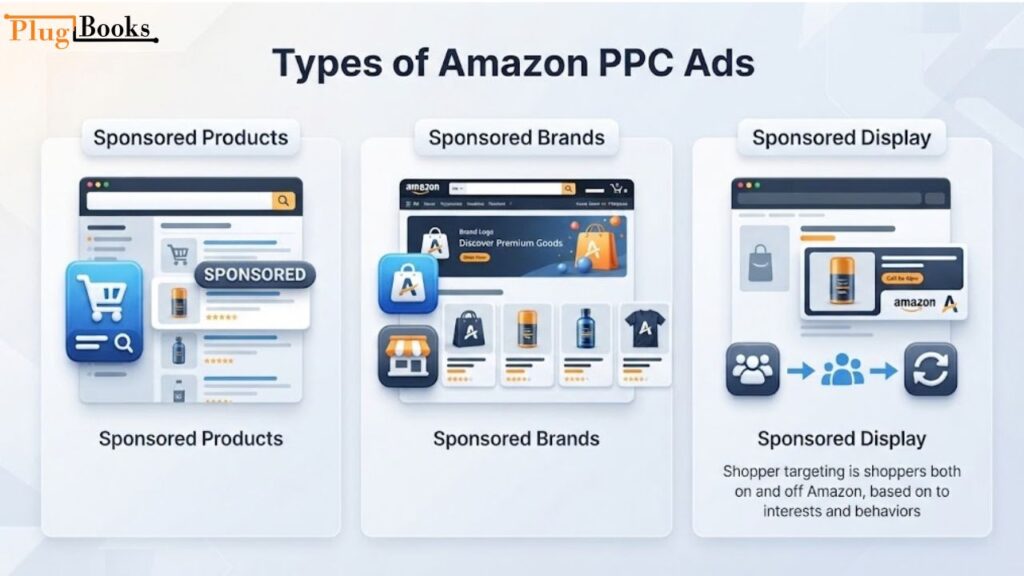
Amazon has a variety of advertising forms, and each of them can be used for different purposes.
1. Sponsored Product Ads
Sponsored Products drive discovery and consideration of individual product listings and appear in shopping results and on product detail pages.
They are also a good place for sellers to begin if they want to market certain products to customers looking for similar things.
Ad Targeting Sponsored Products
There are several ways to target buyers, using relevant search phrases or products, sellers have.
Start with a target that closely resembles your product or service and provide the campaign enough time to gather meaningful data. Before doing anything drastic, look at clicks, orders, ad spend and attributed sales from there.
2. Ads Sponsored Brands
Sponsored Brands are there for brands to display their items and boost their brand visibility within Amazon’s shopping experience.
They might be handy if you want shoppers to explore more than one product or interact with your brand.
Sponsored Brands Ad Formats
Gathering of products
Product Collection campaigns allow you to display a group of comparable products together, giving buyers more than one choice to browse.
Store Highlight
Store Spotlight advertising can link shoppers to different sections of a brand’s Amazon Store.
Video Clip
Sponsored Brands video commercials leverage video to catch attention and tell the story of a product or brand in a more visual style.
Sponsored Brands Ad Targeting
Targeting options may allow advertisers to approach shoppers based on relevant search behaviour, items or other signals available. Impressions alone are not a good indicator of campaign success; the success of the campaign should be gauged based on the campaign aim.
3. Sponsored Display
Sponsored Display advertising enables marketers to engage relevant shoppers throughout Amazon shopping places and re-engage people who have previously shown interest in products.
Targeting choices vary every campaign and account, but sellers can use product, audience or shopping-behavior indications, when available.
How to create a successful Amazon Ad campaign
Choosing an ad format is only half the battle. It requires precise targeting, a sensible budget and regular reviews on performance.
1. Select Related Keywords
Select search terms that are as near to your product as possible and what a potential consumer is likely to type in Amazon.
Targeting well can assist make sure your adverts are seen by shoppers who are more likely to want what you are selling.
2. Choose a Bidding Strategy
Your bids control the competitiveness of your adverts for available places.
Before boosting bids, think about your product margin, competition and campaign objective. More visibility can come with a larger bid, but it can also boost your advertising costs.
3. Set a realistic budget:
Your advertising budget should be aligned with your total business and product margins.
Don’t increase your budget because sales are going up. Look at how much you’re spending to produce those sales and whether the orders you get leave you with enough profit.
4. Monitor Advertising Performance
Track critical data including clicks, ad spend, attributed sales, ACOS, and ROAS.
These data become much more relevant when you compare them with product costs, Amazon fees, fulfilment expenditures and other business costs.
5. Optimisation of Real Data
Search for campaigns, search terms, goods and targeting methods that are delivering useful results.
You may then adjust bids, budgets and targeting depending on what the data is telling you, rather than making changes based on assumptions alone.
6. Test and Improve With Time
There is not always one optimal campaign structure.
Experiment with different keywords, targeting, bids and campaign settings to see what works best for your products. Change things slowly and you can see what modifications are genuinely increasing performance.
How Much Is Amazon Advertising?
Amazon advertising has no single fixed pricing.
Your costs may vary depending on variables such as:
- Contest
- Tenders
- Targeting.
- Click count
- Options for Campaigns
- Type of product
- Advertising budget.
Two suppliers of similar products may have vastly different expenses of advertising.
If you spend $3,000 and produce $10,000 in attributed sales, that doesn’t mean the vendor got $7,000 in profit. You still have to deduct Amazon fees, product costs, fulfillment, refunds and other charges.
The better question isn’t “How much did I spend on ads?” It’s “What did those advertising dollars do for my business after all the relevant costs?”
ACOS and ROAS: Two Numbers Amazon Sellers Should Watch
Two popular advertising measures that sellers can use to analyse campaign performance are ACOS and ROAS.
ACOS – What Is It?
ACOS, or Advertising Cost of Sales, is a way to measure your ad expenditure against the sales your commercials drive.
Let’s say you spend $500 on advertising and earn $2,500 in attributable sales:
The ACOS is $ 500 ÷ $ 2,500 × 100 = 20 %
Simply put, a lower ACOS means you’re paying less on ads for every dollar of sales you get credited to your ads. But a low ACOS doesn’t necessarily mean the campaign is profitable.
Your product margin still counts.
What Is ROAS?
ROAS (Return on Ad Spend) looks at the same relationship the other way around.
With the same example:
ROAS = $2,500 / $500 = 5x
That’s $5 in attributed sales for every $1 you spend on advertising.
ACOS and ROAS are great tools to measure advertising efficiency, but neither convey the whole profit picture on their own. Product costs, Amazon fees, shipping, refunds, and other factors also affect your ultimate margin.
Amazon Ad Sales Versus Organic Sales
It’s important for Amazon sellers to also know the distinction between ad-attributed sales and organic sales.
Ad sales are transactions that can be directly linked to buyers who viewed an Amazon ad prior to their purchase. Organic sales are from shoppers who ordered without being assigned an advertising engagement.This distinction can help you tell what your advertising is actually contributing.
For example, when you start running advertising, total revenues could climb. But if most of the extra revenue is achieved with a big increase in advertising cost, the business may not be making as much profit as the sales numbers show.
Breaking out sponsored vs. organic performance helps you get a better sense of how your items are doing and where your ad spend is having the most impact.
Amazon Ads 2026 Updates
By 2026, Amazon advertising will be more automated and powered by artificial intelligence with new tools to help shoppers engage, manage campaigns and optimise them.
AI-Driven Advertising Tools
Amazon has added AI-driven features across Sponsored Products and Sponsored Brands to help advertisers and shoppers discover more relevant product information and advertising experiences.
AI-Driven Campaign Management
AI technologies such as Ads Agent can aid in certain portions of campaign creation, optimisation and advertising workflows, alleviating some of the human effort of campaign administration.
Sponsored Brand Stores
With Sponsored Brands Collections, advertisers can now exhibit numerous related goods in one ad experience, and for some campaigns, they can use AI-assisted product selection.
AI Shopping Experiences
Amazon is also building advertising opportunities around conversational and AI-driven purchasing experiences. As the way people discover things continues to evolve, this opens up new avenues for sellers and brands to connect with shoppers.
What the Update Means for Vendors
Automation might make it easier to manage campaigns, but it doesn’t take the place of understanding your numbers.
Sellers should continue to track advertising spend, attributed sales, ACOS, ROAS, product costs, Amazon fees and other expenses to evaluate if advertising is enabling profitable growth.
The Impact of Amazon PPC on Seller Earnings
Advertising can improve sales, but the extra revenue only matters if it’s enough to pay for your costs.
Let’s say a product costs $40. Some of that $40 is probably going toward product costs, Amazon fees, fulfillment, shipping, and other charges before you ever advertise.
Then if you spend a lot on promotion to generate the sale, the amount left over can be a lot less.
And that is why you can’t measure a campaign by how many orders it produces.
Don’t ask:
“How many sales were generated by my ads?”
also ask.
How much profit did those sales really make?”
To answer that you need the full picture of your sales and expenses – not just the statistics in your advertising dashboard.
Should You Use an Amazon PPC Agency?
Some sellers run their Amazon advertising in-house, while others turn to an Amazon PPC firm as their campaigns grow more complex.
A PPC agency can help you with:
- Setting up a campaign
- Keyword research
- Bid administration
- Objectives
- Campaign optimisation
- Analysis of advertising performance
If advertising is taking too much of your time or you require more specialised campaign management then it can make sense to get professional support.
But a PPC agency and an accounting firm handle separate elements of the business.
Your advertising team may be looking to improve campaign performance, while your bookkeeping process needs to structure the financial side – covering sales, fees, expenses, refunds, and payouts.
If you keep both sides organised, you will be better able to comprehend if additional advertising is genuinely boosting the business.

Why Financial Tracking Matters for Amazon Ads
As an Amazon firm grows, advertising costs might represent a large percentage of its total costs.
If your finances are not organised, it might be difficult to identify how your advertising expenditure ties into sales, Amazon fees, inventory costs, refunds, payouts and other expenses.
Good bookkeeping makes this figure part of a better organised financial picture.
This makes it easy to see where the money is coming from, where it is going, and if increased income is converting into healthy profit as well.
Financial data is even more vital for sellers conducting various campaigns or selling on multiple channels to maintain organization.
How PlugBooks Helps Amazon Sellers Track Their Finances
PlugBooks simplifies your key financial data in one spot to assist Amazon merchants organise their ecommerce bookkeeping.
It integrates with Amazon and helps track sales, fees, refunds, costs, payouts and other transaction data. This provides sellers with a more systematic approach of keeping their financial data as their firm expands.
For merchants putting money into Amazon advertising, proper bookkeeping can help them comprehend how advertising costs fit into the bigger business picture.
PlugBooks also integrates with eBay and Shopify, and works with QuickBooks and Xero, so it’s useful for merchants with numerous ecommerce channels or other bookkeeping software alongside their sites.
PlugBooks does not run Amazon ads campaigns. Instead, it targets the accounting side of the firm, letting sellers spend less time combing through financial transactions and obtain a better picture of sales, expenses and profitability.

Final Thoughts
Amazon advertising is a great growth strategy but increased sales is only half of the story.
Learn about Amazon PPC, how to organise campaigns, track ACOS and ROAS and how to differentiate between ad-attributed and organic sales for better advertising decisions.
And significantly, maintain ad spend related to the rest of your business finances. All sorts of things impact how much profit you really keep, including Amazon fees, product costs, shipping, returns and more.
As your Amazon business expands, organised bookkeeping will make that financial picture much easier to understand.
FAQs
1. How does Amazon promote products?
Amazon uses paid ads in search results, product pages, and other shopping placements to reach relevant shoppers.
2. What affects Amazon PPC performance?
Keywords, bids, targeting, competition, product relevance, conversion rates, and campaign structure all affect performance.
3. What determines Amazon ad costs?
Costs depend on competition, bids, targeting, clicks, product category, and campaign settings.
4. Is Amazon Ad Spend worth it for small sellers?
It can be, if ad costs fit the product’s profit margin and help reach relevant shoppers.
5. What does ACOS tell an Amazon seller?
ACOS shows how much of attributed sales revenue goes toward advertising.
6. What should sellers consider before increasing ad spend?
Review ad performance, profit margins, conversion rates, Amazon fees, fulfillment costs, and overall profitability.
7. How should Amazon advertising expenses be recorded?
Track ad costs alongside sales, fees, inventory, refunds, and other business expenses to understand actual profitability.
8. Can Amazon Promotional Ads improve organic sales?
Ads can increase visibility and sales, but they do not guarantee higher organic rankings. Track paid and organic sales separately.
9. What is the difference between ACOS and ROAS?
ACOS measures ad spend as a percentage of attributed sales, while ROAS shows sales generated for each dollar spent on ads.