




Selling on eBay can be a great way to earn extra income or build a full-time online business, but understanding eBay listing fees is essential before you price your products. Knowing what you may pay to list, sell, promote, and ship an item helps you set realistic prices and protect your profit margins.
eBay’s costs can vary depending on your seller account, product category, listing format, Store subscription, and optional services. This guide explains how these costs work in 2026 and shares practical ways to keep unnecessary selling expenses under control.
What Are eBay Listing Fees?
eBay mainly charges sellers through two types of fees: insertion fees and final value fees.
An insertion fee may apply when you create a listing after using your monthly zero-insertion-fee allowance. A final value fee is charged when your item sells.
According to eBay’s current fee information, sellers without an eBay Store can receive up to 250 zero-insertion-fee listings per month on eBay.com. Once that allowance is used, the standard insertion fee for most categories is $0.35 per listing, although category exclusions and other conditions apply.
Final value fees are different. They depend on the category, sale amount, Store subscription, and other factors.

How Much Does It Cost to List on eBay in 2026?
For many sellers, creating a listing does not immediately result in a listing charge because of eBay’s monthly zero-insertion-fee allowance.
For sellers without a Store:
- Up to 250 listings may qualify for zero insertion fees each month.
- After the allowance is used, most additional listings cost $0.35 each.
- Optional listing upgrades can create additional charges.
- Certain categories have different rules or exclusions.
- Good ‘Til Cancelled listings can count toward the monthly allowance when they renew.
This means sellers should not assume that every listing is automatically free. Your account type, category, and monthly listing activity all matter.
What Is the Final Value Fee on eBay?
The final value fee is charged after an item sells. Unlike an insertion fee, it is tied to the completed sale.
For most categories, eBay currently lists a final value fee of 13.6% on the total amount of the sale up to $7,500 per item, plus 2.35% on the portion above $7,500. A per-order fee also applies.
The exact percentage is not universal. Books, clothing, collectibles, electronics, jewelry, and other categories can have different rates. Store subscribers can also receive different fee structures.
The total amount used to calculate the final value fee can include the item price, shipping, sales tax, and other applicable amounts, depending on the fee rules.
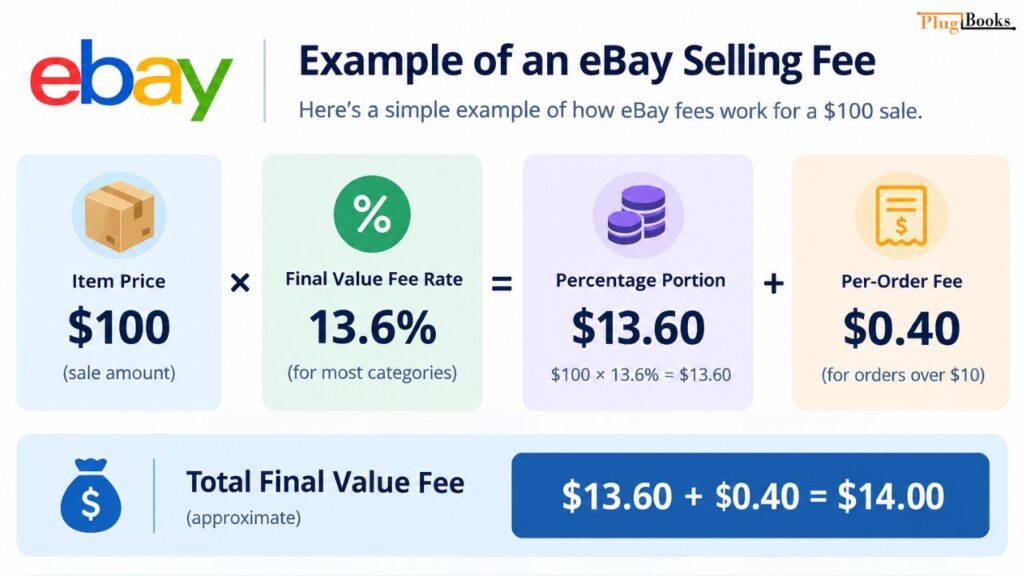
Example of an eBay Selling Fee
Suppose you sell an item in a category covered by the standard rate for $100.
If the applicable final value fee is 13.6%, the percentage portion would be:
$100 × 13.6% = $13.60
For an order above $10, the current standard per-order fee is another $0.40.
So the basic final value fee would be approximately:
$13.60 + $0.40 = $14.00
This is a simplified example. Your actual cost can differ based on the category, Store subscription, shipping, taxes, promotions, and other applicable charges.
What Other eBay Selling Costs Should You Know About?
Listing and final value fees are not the only expenses sellers may encounter.
Optional Listing Upgrades
Some optional listing features can add charges. These may include services such as subtitles, additional categories, or certain promotional and listing enhancements.
Because optional fees can change, sellers should check the current fee shown by eBay before selecting an upgrade.
A useful rule is simple: only pay for an upgrade when you have a clear reason to expect it will improve your listing’s performance.
Promoted Listings
Promoted Listings can help increase product visibility, but advertising costs can reduce your profit.
Before promoting an item, calculate whether the expected increase in sales is worth the additional advertising expense.
Shipping Costs
Shipping is another major expense that can affect your actual profit. Even when the buyer pays for shipping, sellers should account for packaging materials, shipping labels, and any difference between the amount charged and the actual shipping cost.
Are Auction and Fixed-Price Listings Charged Differently?
eBay offers both auction-style and fixed-price selling formats.
With a fixed-price listing, you set the price and allow buyers to purchase the item directly.
With an auction-style listing, buyers compete by placing bids, and the highest eligible bid generally determines the selling price.
The fee structure depends on your account, category, and listing circumstances rather than simply whether you choose auction or fixed price. eBay also has specific rules for zero-insertion-fee listings and auction-style listings.
For many sellers, fixed-price listings are easier to manage because they provide more predictable pricing. However, auctions can still make sense for collectible, rare, or high-demand products where buyer competition may increase the final selling price.
How Can You Reduce eBay Selling Fees in 2026?
Reducing costs does not mean avoiding every fee. Instead, smart sellers focus on eliminating unnecessary expenses.
1. Use Your Free Listing Allowance
If you receive 250 zero-insertion-fee listings, plan your inventory around that allowance whenever possible.
Remember that relisted and automatically renewed listings can also count toward your monthly allocation.
2. Review Your eBay Store Strategy
High-volume sellers may benefit from an eBay Store because Store subscriptions can provide larger zero-insertion-fee allowances and different final value fee rates.
For example, eBay currently lists substantially higher monthly listing allowances for Basic and higher Store plans.
However, a Store subscription is not automatically cheaper for every seller. Compare your monthly listing volume and sales against the subscription cost before upgrading.
3. Choose the Right Product Category
Your category can affect the final value fee.
Before publishing a listing, make sure the product is placed in the most accurate category allowed by eBay. Choosing a category simply because it appears cheaper can create policy problems and may not accurately represent your item.
4. Avoid Unnecessary Listing Upgrades
Paid enhancements can add up quickly when you have dozens or hundreds of products.
Instead of upgrading every listing, test which features actually improve visibility or conversions.
5. Calculate Profit Before Listing
Do not look only at the selling price.
A better calculation is:
Net Profit = Sale Revenue − eBay Fees − Product Cost − Shipping − Advertising − Other Expenses
For example, a product that sells for $100 is not necessarily a $100 profit opportunity. After marketplace fees, product costs, shipping, advertising, and other expenses, your actual profit could be much lower.
6. Track Fees Across Your Entire Store
Individual fees may seem small, but they can become significant when you sell hundreds of products.
Tracking revenue, fees, refunds, payouts, and other expenses gives you a much clearer picture of which products are actually profitable.
How Can PlugBooks Help eBay Sellers Track Costs?
Managing eBay sales manually can become difficult as your store grows, especially when you’re trying to keep track of eBay listing fees, selling expenses, payouts, and revenue.
PlugBooks helps sellers connect marketplace activity with accounting workflows so they can keep better track of sales, fees, expenses, and payouts.
Instead of reviewing individual transactions one by one, sellers can use accounting automation to organize financial information and get a clearer picture of where their money is going.
This can be especially useful for sellers who operate across multiple marketplaces and need a consistent view of revenue, eBay listing fees, and other selling expenses.

Quick Comparison of Common eBay Selling Costs
| Cost | When It Applies | What to Watch |
| Insertion fee | After your zero-insertion allowance is used | Most additional listings are $0.35 |
| Final value fee | When an item sells | Rate varies by category |
| Per-order fee | When an item sells | Current standard amount depends on order value |
| Optional upgrades | When selected | Can increase listing costs |
| Promoted Listings | When advertising is used | Reduces profit from sales |
| Shipping | When fulfilling an order | Include packaging and label costs |
eBay’s current fee structure includes category-specific exceptions, so sellers should always check the fee applicable to their particular product before calculating expected profit.
Frequently Asked Questions
Are eBay listings free in 2026?
Many sellers receive a monthly allocation of zero-insertion-fee listings. On eBay.com, sellers without a Store can receive up to 250 such listings per month, subject to category restrictions and other conditions.
What happens after I use my free eBay listings?
For most categories, additional listings are charged an insertion fee of $0.35 per listing. Some categories have different rules or exclusions.
Does eBay charge a fee when an item sells?
Yes. eBay generally charges a final value fee when an item sells. The rate depends on the category, sale amount, Store subscription, and other applicable conditions.
Are eBay fees the same for every product?
No. eBay uses different fee rates for different categories and seller types. Store subscribers may also receive different rates from sellers without a Store.
Is an eBay Store worth the cost?
It depends on your sales and listing volume. A Store may make sense for sellers who need more zero-insertion-fee listings or can benefit from lower category-specific selling fees. Compare the subscription cost with your expected savings before upgrading.
How can I keep track of eBay selling expenses?
Use eBay’s Seller Hub and financial statements to review fees and payouts. For sellers managing larger volumes or multiple marketplaces, accounting automation can make ongoing tracking and reconciliation easier.
Final Thoughts
Understanding eBay listing fees is an important part of running a profitable store in 2026. The cost of selling is not limited to the price you see when creating a listing. Insertion fees, final value fees, advertising, shipping, and other expenses can all affect your bottom line.
The smartest approach is to calculate your expected costs before listing, use your zero-insertion-fee allowance carefully, avoid unnecessary upgrades, and regularly review your actual profit.

3 thoughts on “eBay Listing Fees 2026: How Smart Sellers Save Big”