



Online stores can attract thousands of visitors and still struggle to generate enough orders. Shoppers may browse products, compare prices, add items to their carts, and leave without completing a purchase. Ecommerce conversion rate optimization helps sellers identify these obstacles and improve the shopping experience using customer behavior, analytics, and testing.
In 2026, online shopping continues to evolve through AI-assisted product discovery, personalized recommendations, mobile commerce, and more convenient payment experiences. Businesses must adapt to these changes while maintaining customer trust and protecting profitability. Effective ecommerce conversion rate optimization focuses not only on generating more orders but also on understanding which improvements deliver sustainable business results.
What Is Ecommerce Conversion Rate Optimization?
Ecommerce conversion rate optimization is the process of improving an online store to increase the percentage of visitors who complete a desired action. The main goal is usually to generate purchases, although conversions may also include newsletter subscriptions, account registrations, and product additions to a shopping cart.
The basic purchase conversion rate formula is:
Conversion Rate = (Number of Purchases ÷ Total Visitors) × 100
For example, imagine an online store receives 2,000 visitors and generates 50 purchases. Its conversion rate is 2.5%. If the same store generates 60 purchases from 2,000 visitors after improving its product pages and checkout, its conversion rate increases to 3%.
This example illustrates how ecommerce conversion rate optimization can help a store generate additional orders without necessarily increasing its traffic.
However, businesses should define their measurement method consistently. Conversion rates based on users, sessions, or visitors can differ. Store owners should also evaluate average order value, refunds, acquisition costs, and profit margins to understand whether improvements benefit the business financially.
Why Conversion Rate Optimization Is Important for Online Stores
Understanding why conversion rate optimization is important starts with recognizing the investment required to attract shoppers. Search engine optimization, paid advertising, social media campaigns, and email marketing all require resources. When visitors leave because of confusing navigation, incomplete product information, or unexpected checkout costs, businesses may lose potential sales.
A well-planned optimization strategy can help stores make better use of existing traffic, improve customer satisfaction, and identify weaknesses in the purchasing journey. It can also help sellers understand differences between mobile and desktop performance, new and returning customers, and different marketing channels.
Nevertheless, a higher conversion rate does not automatically mean higher profit. Heavy discounts may encourage purchases but reduce margins. Advertising costs, shipping expenses, product costs, and refunds can also affect the final result.
For this reason, sellers should evaluate conversions alongside order value, customer acquisition costs, return rates, and profitability.
10 Ecommerce Conversion Optimization Strategies for 2026
The following strategies provide a practical starting point for an effective ecommerce conversion optimization plan. Start with problems supported by analytics or customer feedback, then prioritize changes according to their potential impact.
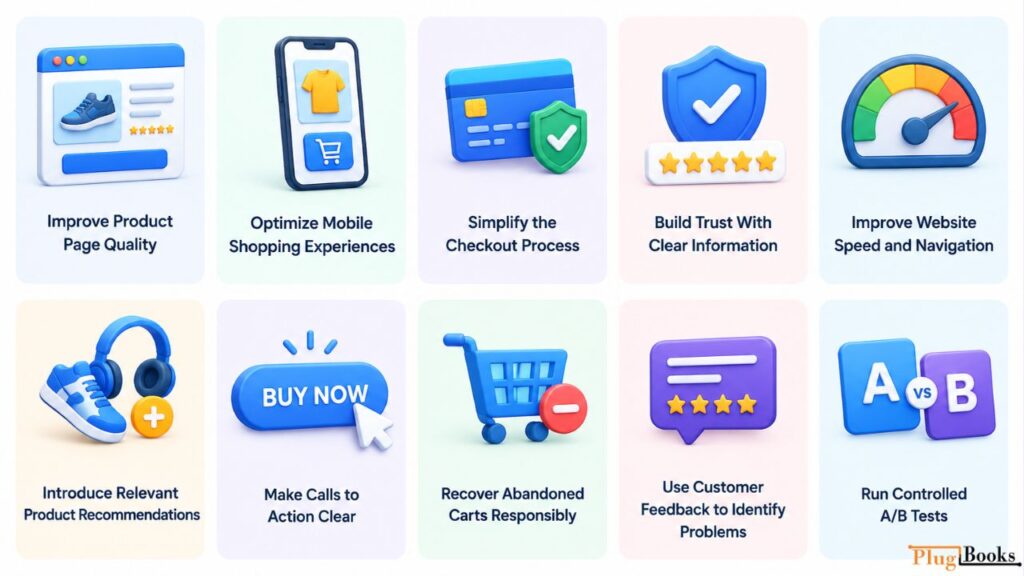
1. Improve Product Page Quality
Product pages should answer customer questions before shoppers need to contact support. Use clear images from multiple angles, accurate descriptions, visible pricing, and useful information about sizing, materials, compatibility, and availability.
Make shipping information and return policies easy to locate. Use descriptive product titles and highlight the features that matter most to the intended audience.
For stores selling across multiple marketplaces, maintain consistent product details wherever possible. Inaccurate descriptions can create uncertainty, discourage purchases, and increase returns.
2. Optimize Mobile Shopping Experiences
Mobile shoppers need pages that load efficiently and provide straightforward navigation. Use readable text, appropriately sized buttons, and product images that display correctly on smaller screens.
Test the entire shopping journey on mobile devices, including product selection, cart updates, address entry, payment, and order confirmation.
Compare mobile and desktop conversion rates to identify potential usability problems. If mobile visitors add products to their carts but rarely complete purchases, investigate checkout friction before investing more heavily in traffic acquisition.
3. Simplify the Checkout Process
A complicated checkout can prevent interested shoppers from completing orders. Request only necessary information, support guest checkout where appropriate, and display shipping costs before customers reach the final payment step.
Offer payment methods that suit your audience and clearly explain delivery times, taxes, and return conditions. Digital wallets and streamlined checkout options can reduce unnecessary steps, although their effectiveness depends on customer preferences and availability.
According to Stripe’s 2026 checkout analysis, payment preferences and mobile checkout experiences are important considerations for online businesses.
4. Build Trust With Clear Information
Customers are more likely to consider purchasing when they understand who they are buying from and what happens after checkout.
Display genuine reviews, accurate delivery estimates, accessible contact information, and transparent return policies. Provide relevant security information without making unsupported guarantees.
Avoid fake countdown timers, misleading discounts, and exaggerated product claims. These tactics may create short-term urgency but can damage customer confidence and long-term loyalty.
5. Improve Website Speed and Navigation
Slow pages and confusing menus make products harder to discover. Compress large images, review unnecessary scripts, remove outdated apps, and organize categories around customer needs.
Use descriptive navigation labels and ensure internal search returns relevant results. Check important landing pages individually because performance can vary between product pages, category pages, and the homepage.
A useful optimization process connects technical performance with customer behavior rather than treating page speed as an isolated metric.
6. Introduce Relevant Product Recommendations
Recommend complementary products when they help shoppers make better purchasing decisions. For example, a seller might suggest compatible accessories or create a bundle of items commonly purchased together.
In 2026, AI-assisted shopping and personalization offer additional ways to help customers discover relevant products. However, recommendations should remain useful, transparent, and respectful of customer privacy.
Use first-party customer information responsibly, obtain consent where required, and avoid collecting unnecessary data. Test recommendations against a clear baseline to determine whether they increase completed orders or average order value without reducing profitability.
7. Make Calls to Action Clear
Use direct labels such as “Add to Cart,” “Buy Now,” or “Choose Your Size” when they accurately describe the next step.
Make important buttons easy to locate, maintain sufficient contrast, and avoid filling product pages with competing banners and pop-ups.
Test different layouts and wording when analytics indicate that customers are struggling to move forward. Do not assume that one button color or phrase will work equally well for every audience.
8. Recover Abandoned Carts Responsibly
Cart abandonment happens when shoppers add products but leave before completing their orders. Reminder emails can bring customers back by displaying the products they considered and providing a direct link to their carts.
Explain relevant shipping details or answer common product questions where appropriate. Respect marketing consent, privacy requirements, and customer communication preferences.
Before offering discounts, investigate why shoppers abandon their carts. A confusing payment form or unexpected shipping charge may require a different solution from price sensitivity.
9. Use Customer Feedback to Identify Problems
Analytics show what customers do, while feedback can help explain why they behave that way.
Review support tickets, product questions, customer surveys, and on-site search terms. If customers repeatedly ask about product compatibility or delivery dates, make that information easier to find.
Combine feedback with behavioral data before prioritizing changes. A small number of comments can reveal a useful hypothesis, but additional evidence helps determine whether the problem affects a significant portion of your audience.
10. Run Controlled A/B Tests
A/B testing compares two versions of a page or feature to determine which performs better against a defined goal. You might compare two product page layouts, checkout flows, or calls to action.
Define your primary metric before testing and allow enough data to accumulate. Avoid declaring a winner based on a small sample or an unusually strong sales day.
Track secondary measures such as average order value, refunds, and margin. A change that increases purchases but substantially reduces profit may not be the best option.
Conversion Rate Optimization Examples for Ecommerce Stores
These conversion rate optimization examples illustrate how businesses can turn customer behavior into practical experiments.
Example 1: Clearer shipping information
An online store notices that many shoppers leave during checkout. The business makes delivery costs and estimated arrival dates visible earlier. It then compares checkout completion before and after the change, accounting for traffic and seasonal differences.
Example 2: Better product information
Customers frequently contact support to ask whether a product is compatible with a particular device. The store adds a compatibility chart and clearer images. It measures product purchases, support requests, and returns to evaluate the improvement.
Example 3: A simpler mobile checkout
Mobile visitors add products to their carts but complete fewer purchases than desktop visitors. Testing reveals that the checkout form is difficult to use on smaller screens. The store simplifies the form and monitors completed purchases and checkout errors.
These scenarios are illustrative rather than guaranteed outcomes. Results depend on the product, audience, implementation, and traffic quality.
How to Measure Ecommerce Performance in 2026
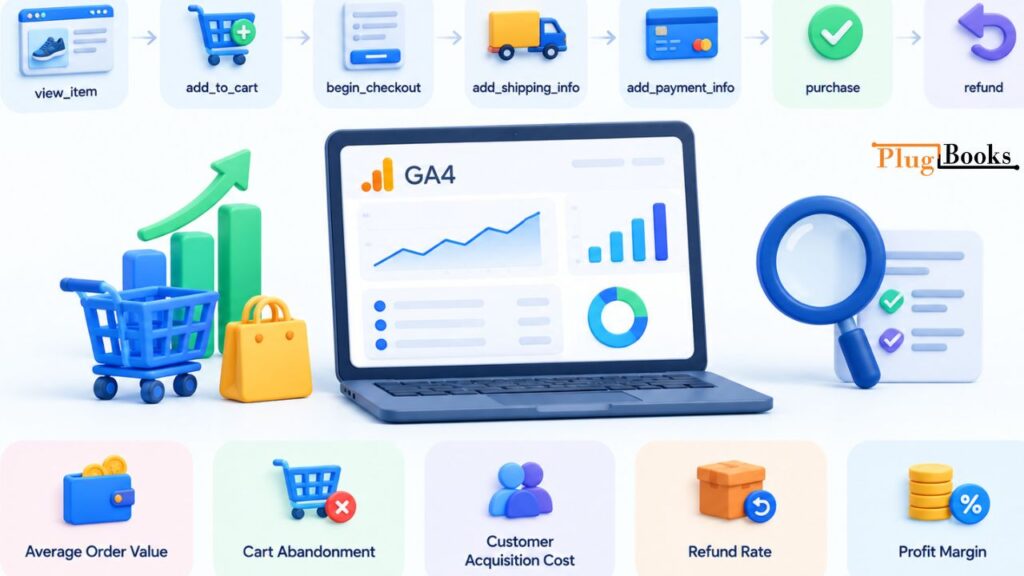
A successful ecommerce conversion rate optimization program requires reliable measurement. Google Analytics 4 (GA4) supports ecommerce events that help businesses understand how shoppers move through the purchase journey.
Relevant events include view_item, add_to_cart, begin_checkout, add_shipping_info, add_payment_info, purchase, and refund. These events help identify where customers engage, where they abandon the process, and which products contribute to sales.
Google explains how to configure these measurements in its official GA4 ecommerce events documentation. Store owners should verify that events and transaction values are configured correctly because ecommerce events are not all collected automatically.
Alongside conversion rate, monitor:
- Average order value: The average amount customers spend per order.
- Cart abandonment: The proportion of shopping carts that do not result in purchases, using a consistent measurement method.
- Customer acquisition cost: The cost of acquiring a customer through marketing and sales activities.
- Refund rate: The proportion or value of orders that are refunded.
- Profit margin: The share of revenue remaining after the relevant costs are accounted for.
A practical conversion rate optimisation guide should explain how to use these metrics together rather than focusing exclusively on the number of completed orders.
Common CRO Mistakes to Avoid
One common mistake is changing several elements at once and then being unable to identify which change influenced results. Another is copying competitors without understanding differences in audience, pricing, or business models.
Businesses should also avoid running tests for too little time, ignoring seasonal fluctuations, and assuming every increase in traffic will improve sales. More visitors are useful only when the store can attract relevant shoppers and provide a suitable purchasing experience.
A reliable conversion rate optimisation guide follows a repeatable process: identify a problem, review the evidence, develop a hypothesis, prioritize the change, test it, and document the results.
The process should also account for customer satisfaction and profitability. This approach makes optimization more systematic and helps businesses decide which improvements deserve further investment.
Benefits of Conversion Rate Optimization for Ecommerce Businesses
The benefits of conversion rate optimization can include generating more purchases from existing traffic, reducing friction in the shopping journey, improving product discovery, and gaining a clearer understanding of customer behavior.
Better product information may also help shoppers choose suitable items, potentially reducing avoidable returns and support requests. More efficient checkout experiences can make purchasing easier, while structured testing helps businesses replace assumptions with evidence.
Another important benefit is better resource allocation. Instead of spending more on advertising immediately, businesses can investigate whether existing visitors encounter preventable obstacles.
To evaluate the benefits of conversion rate optimization, review changes in conversion, average order value, customer acquisition costs, refunds, and profitability. No single metric tells the whole story, and improvements should support both customer needs and sustainable business growth.
How PlugBooks Helps Ecommerce Sellers Track Profitability
Improving conversions can increase order volume, but sellers still need to understand how much revenue remains after business costs.
Advertising expenses, refunds, marketplace fees, shipping costs, and cost of goods sold can all affect profitability. Without organized financial records, it may be difficult to determine whether a successful marketing or website experiment actually improved the business’s financial position.
PlugBooks helps ecommerce sellers organize bookkeeping and track financial activity across supported sales channels, including Amazon, eBay, and Shopify. Sellers can use financial records to review sales, refunds, fees, expenses, settlements, payouts, and cost of goods sold.
By reviewing conversion metrics alongside bookkeeping data, businesses can better understand the relationship between orders and profit. PlugBooks complements website analytics by helping sellers organize their financial information for more informed business decisions.

Conclusion
Ecommerce conversion rate optimization is an ongoing process that combines customer research, website improvements, analytics, and controlled testing. In 2026, sellers should pay particular attention to mobile usability, AI-assisted discovery, responsible personalization, convenient checkout, and accurate measurement.
Start by identifying the biggest barriers in your store, test improvements carefully, and measure their effects on both customer experience and financial performance. When you combine a smoother shopping journey with reliable bookkeeping, you can make better decisions about sustainable ecommerce growth.
FAQs
1. What is a good ecommerce conversion rate?
There is no universal benchmark for every online store. Conversion rates vary by industry, product price, traffic source, device, and customer intent. Compare your results with relevant benchmarks and your own historical performance.
2. How often should an ecommerce store test change?
Test when you have a clear hypothesis, enough relevant data, and a meaningful improvement to investigate. Smaller stores may benefit from usability research and prioritizing high-impact issues before running multiple experiments.
3. Does a higher conversion rate always mean higher profit?
No. Discounts, advertising costs, refunds, fulfillment expenses, and product costs can reduce profit even when more visitors make purchases. Evaluate conversion alongside order value, expenses, and margins.
4. How can ecommerce sellers track the financial impact of CRO?
Compare sales and order volume before and after a change, then review related refunds, fees, advertising expenses, and cost of goods sold. Accurate bookkeeping helps sellers understand whether additional revenue translates into stronger profitability.
5. How Can Businesses Build an Effective CRO Ecommerce Strategy?
An effective CRO ecommerce strategy starts with identifying customer friction through analytics, user feedback, and checkout data. Prioritize high-impact issues, test targeted improvements, and measure their effects on purchases, average order value, and profit to support sustainable growth.
