



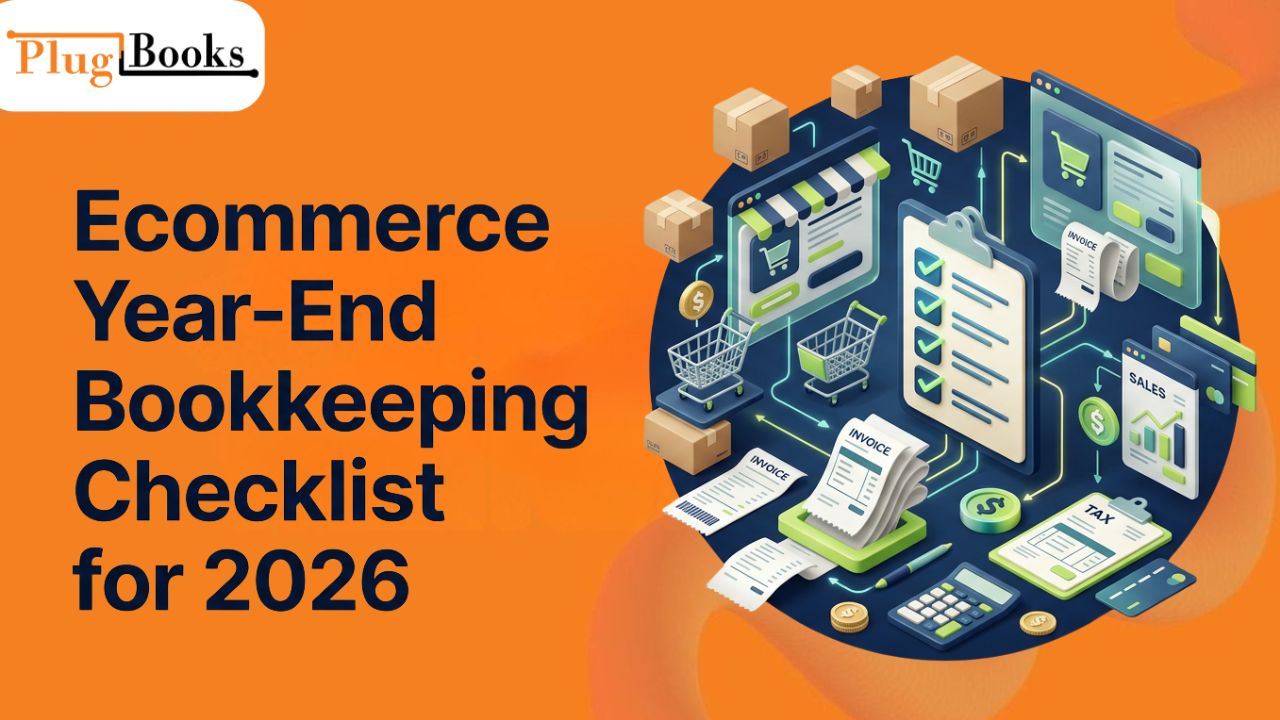
Ecommerce year end bookkeeping checklist: Running an online store means managing more than orders and sales. Throughout the year, ecommerce sellers deal with marketplace fees, refunds, supplier invoices, inventory costs, advertising expenses, and payouts that do not always match their sales totals. Without organized records, reviewing these transactions at year-end can become stressful and time-consuming.
This checklist will help Amazon, eBay, and Shopify sellers prepare their financial records before December 31, 2026. You will learn how to reconcile marketplace payouts, verify inventory, organize expenses, prepare for 1099 reporting, and build a complete document package for your CPA.
Starting in October gives you time to identify missing records and resolve discrepancies before tax season begins.
Why You Should Start Your Ecommerce Year End Bookkeeping Checklist in October
If you wait until December to evaluate your accounts you could find yourself scurrying for invoices, chasing down missing payments or correcting inventory records. If you reach out earlier, you can check transactions, reach out to suppliers and solve difficulties when help papers are easier to get.
Vendors selling through many channels benefit notably from early preparation. Amazon, eBay, and Shopify may show sales, refunds, fees, and payment information differently. Go over these documents together to get a sense for how your business is doing financially overall and how to plan for the last quarter.
Ecommerce Year-End Bookkeeping Checklist for 2026
1. Reconcile Marketplace Sales and Payouts
Fees, refunds, advertising costs and other adjustments are deducted before a platform makes a payout, so marketplace deposits will rarely be equal to total purchases.
- Download sales, transaction and settlement reports for all marketplaces.
- Match deposits to disbursements in your business bank account.
- Review refunds and commissions, costs of sales and other changes.
- Calculate missing deposits, outstanding balances and retained cash.
- Verify differences between your accounting system and platform data.
Let’s say your marketplace has $10,000 in sales, $500 in refunds, and $800 in fees. The expected net total is $8,700, before further adjustments.
Recording the $8,700 deposit as income could understate sales, and hide expenses taken prior to payment. Keep the underlying amounts classified according to your accounting system.
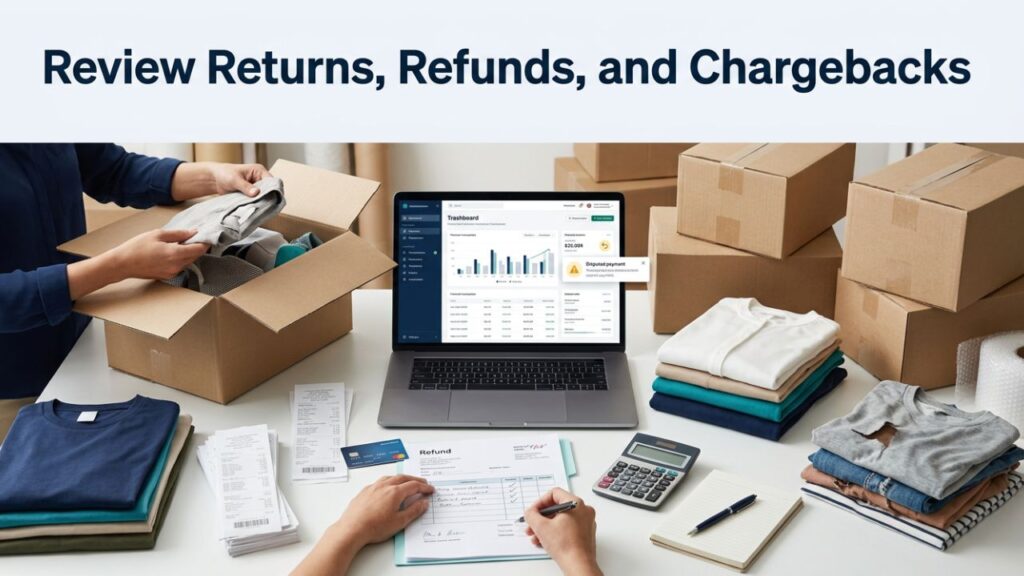
2. Refunds, returns and chargebacks review
Returns affect sales, inventory, transportation expenses and profitability. Check for any outstanding transactions, particularly those made in late December.
- Check that refunds are posted.
- Verify that the returned goods are resalable.
- Document of damaged and unsellable stock.
- Study chargebacks, dispute costs and related amendments.
- Research refunds that fall within a different settlement term than the original sale.
A refund isn’t automatically a return to inventory. Before adjusting stock quantities check what happened to the item.
3. Review Inventory and Cost of Goods Sold
Inventory affects the bottom line of the final balance sheet of the year and the cost of goods sold. Incorrect product costs or quantities can distort your stated profitability.
- Compare inventory with physical inventory or other reliable verification techniques.
- Inspect products in warehouses and delivery centers.
- Identify stock that is missing, damaged, obsolete or unable to be sold.
- Check supplier invoices, and cost of procurement of products.
- Review the freight and other costs that are in inventory in your accounting system.
- Write-off and substantial changes in inventory.
Say you have a record of 500 units but an independent count shows only 470. You investigate the difference of 30 units before you modify your records. The shortfall could be due to returns, variations in fulfilment, damage or recording errors.
4. Record Business Expenses & Supplier Invoices
If expenses are forgotten, your firm can look more profitable than it really is. Verify that business expenses are being reported correctly by checking bank statements, credit card statements, receipts and supplier invoices.
Special attention:
- Market commissions and transaction expenses.
- Advertising and sales promotion costs.
- Shipping, Packaging & Delivery charges.
- Enterprise services and software subscriptions.
- Bills and invoices from suppliers outstanding.
- Major corporate outlays, such as capital expenditures.
Look for duplicate entries, missing receipts and expenses assigned to the wrong category. Create a process to identify and document corporate purchases on personal accounts.
Remember that the date you actually pay the bill may not coincide with the date the expense is recognised, depending on the accounting system you use and the type of transaction.
5. Verify Sales Tax & Other Tax Records
For ecommerce retailers, tax records can be distributed between marketplaces, payment processors, and their own online stores. When you file these early it will make tax prep a breeze.
Review relevant sales tax reports, marketplace collected tax records, filing confirmations, payment receipts, and exemption documentation. US merchants must be aware of the obligations they have in the states they do business or have tax obligations applicable to.
Don’t assume every marketplace tax amount is a tax collected by your firm. Marketplace facilitator rules may require platforms to collect and remit certain taxes on behalf of sellers.
Sellers that sell internationally additionally need to consider any VAT, GST, customs and other indirect tax filings. The rules differ by jurisdiction, so examine the rules that apply to your business.
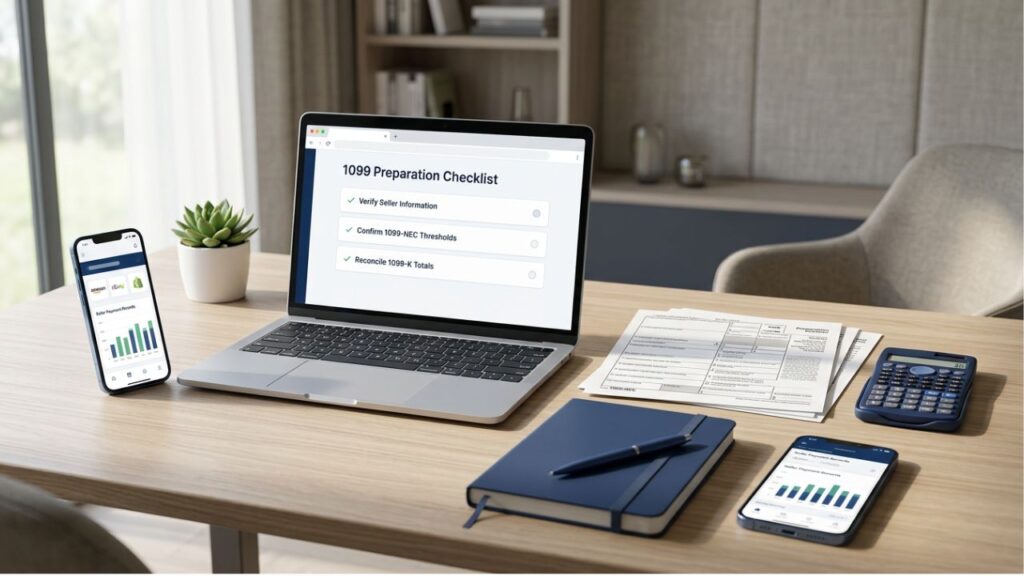
6. Prepare for 1099s and Verify Tax Reporting Records
Review the tax documentation your e-commerce business may get or need to fill out before tax time.
In the United States, the sellers are often issued a Form 1099-K for payment transactions processed by relevant payment settlement entities. The sum stated is not necessarily your taxable profit as it may exclude any refunds and fees and other adjustments.
Use this checklist:
- Confirm your business and taxpayer information with the appropriate platforms.
- Review the 1099-K forms issued.
- Compare stated figures with data held by payment processors and marketplaces.
- Compare the payments recorded to your bookkeeping totals.
- Save settlement statements, transaction reports and refund records.
- Determine if you need to file Form 1099-NEC for reportable payments to contractors.
Not all vendors will have the same forms, or filing requirements. Federal reporting standards and state regulations may differ and suitable thresholds may vary. Check the rules for the 2026 tax year in the current IRS guidelines or with a qualified tax professional.
7. Review Loans, Assets, and Outstanding Liabilities
At year-end, your records should represent what you own and owe, not just the cash in your bank account.
Review business loans, credit card balances, delinquent supplier payments, deposits to suppliers, accrued expenses and other outstanding liabilities. Compare the balances to statements and supporting documentation
Examine purchases of equipment and other corporate assets. Depending on the accounting and tax regulations in question, some purchases may have to be capitalised and not treated as regular operating expenses.
Clearing these amounts will make your financial accounts more representative of the firm.
8. Prepare Your Year-End Financial Statements
Once your transactions and balances have been reviewed, generate the financial reports needed to evaluate your business.
Profit and loss statement. Focus on sales, refunds, COGS, operating expenses, and net profit.
Balance sheet: Verify cash, inventories, accounts receivable, loans and other assets and liabilities.
Cash flow report: See how money moved in and out of your company, what you paid, what you bought for inventory and operational expenses.
Inventory & COGS summary: Review ending inventory numbers & product costs.
Marketplace reports: Look at sales, fees and refunds per channel to find out how profitable each one is.
Go review these reports together. Even a successful corporation might be cash-poor if it has too much tied up in inventory or marketplace balances.
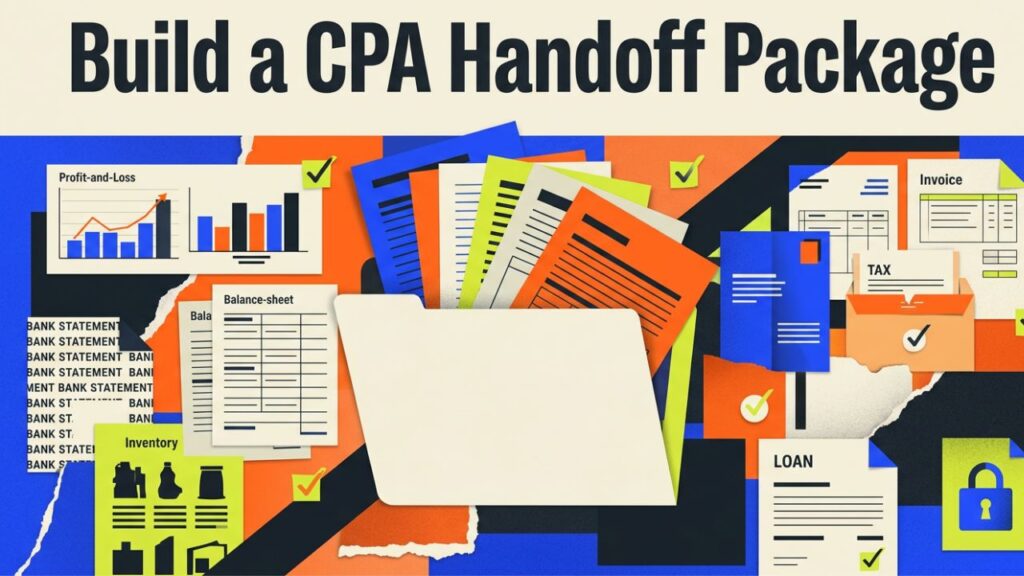
9. Build a CPA Handoff Package
Getting ready for your certified public accountant (CPA) can make year-end review and tax planning easier. Instead of sending loads of spreadsheets and receipts, bring the key financial documents together into one clearly designated folder.
Includes:
- Financial statements: Income statement, balance sheet and the relevant cash flow statements.
- Marketplace records – Sales reports, settlement statements, fee summaries and refund logs.
- Bank and credit card statements: Statements for the reporting period and the correct amounts at year end.
- Inventory documentation: Year-end balances, valuation information, COGS calculations and explanations of material changes.
- Expense records: Supplier invoices, receipts, outstanding bills, major purchase paperwork.
- Tax information: 1099-K forms, appropriate contractor payment information, sales tax information.
- Loan & asset details Loan statements, interest records, equipment purchase papers.
- Outstanding questions: Missing invoices, unexplained payout discrepancies and unresolved book-keeping issues.
Before sending the box along, be sure the reports are for the correct time period and any things that are not complete are correctly noted. Keep sensitive financial and tax information in a secure file sharing system.
A complete handoff doesn’t ensure every transaction is correct, but it does provide your CPA a better starting place and can reduce unwanted follow-up questions.
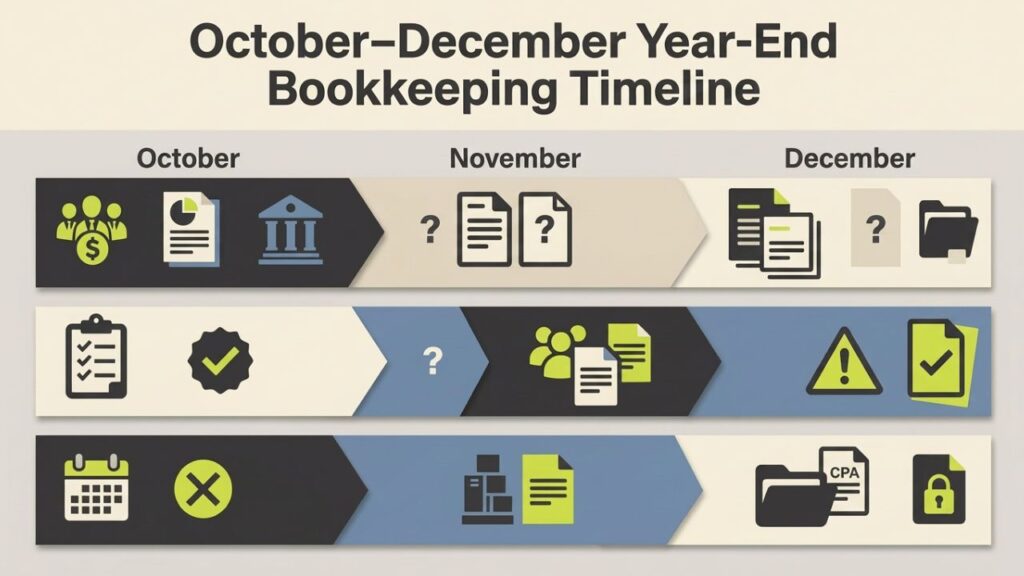
Year-End Bookkeeping Schedule October-December
If possible, spread the effort throughout the previous three months, rather than doing it all in the last week of December.
October: Locate Missing Records
- Collect bank statements and marketplace reports.
- Verify payout discrepancies and missing invoice.
- Locate open refund requests and inventory variances.
November: Deal with outstanding concerns
- Follow up supplier documentation.
- Check spending, liabilities and tax papers.
- Look for unusual inventory variances and transaction differences.
December: Year-end close preparation
- Count inventory at the end of the year.
- Gather final transaction and settlement information.
- Document of changes and balances.”
- Prepare financial reports and CPA hand-off packet.
As part of your ecommerce year end bookkeeping checklist, remember that some marketplace settlements and tax documents may become available only after year-end. Record transactions in the appropriate period under your accounting method, and update your bookkeeping records when the final documents arrive.
PlugBooks: Getting E-Commerce Sellers Ready for Year End
Keeping marketplace transactions, fees, refunds and payouts managed throughout the year can reduce the effort necessary in year-end planning.
PlugBooks has bookkeeping procedures for Amazon, eBay and Shopify sellers. It helps sellers arrange their financial information, assess their transaction activity, understand marketplace expenses and provide reports for their bookkeeping process.
At the end of the year, sellers can turn to their well arranged records for an overview of sales activity, refunds, expenses and payouts. PlugBooks also connects with compatible QuickBooks and Xero workflows, allowing organisations to include marketplace information into their larger bookkeeping system.
PlugBooks is not a substitute for inventory verification, missing-document follow-up or professional tax advice. But if you keep your documents organised throughout the year, it will make your financial reviews and handoffs to your CPA much easier to manage.
If you’re selling across many ecommerce platforms, check out PlugBooks to see if its bookkeeping processes are a good fit for your business.

Common Questions
When should ecommerce sellers start year-end bookkeeping?
October is a useful time to begin reviewing transactions, collecting invoices, reconciling payouts, and identifying inventory discrepancies before the December 31 year-end.
What records should ecommerce sellers prepare before December 31?
Gather marketplace statements, bank and credit card records, supplier invoices, expense receipts, inventory reports, refund records, loan statements, and relevant tax documentation.
How do you reconcile Amazon payouts at year-end?
Compare settlement reports with bookkeeping records and bank deposits. Review sales, refunds, fees, adjustments, and hold balances to explain any differences.
What is included in a CPA handoff package?
A CPA handoff package typically includes financial statements, marketplace reports, bank statements, inventory documentation, expense records, available tax forms, loan information, and a list of unresolved issues.
Does every ecommerce seller need Form 1099-K?
No. Whether a seller receives Form 1099-K depends on applicable federal reporting rules, payment arrangements, and potentially state requirements. Verify the rules relevant to your business and tax year.
Can bookkeeping software help prepare tax-ready records?
Bookkeeping software can help organize transactions and financial reports. Sellers must still verify their records, retain supporting documents, and confirm tax requirements with a qualified professional when necessary.

Conclusion
Year-end bookkeeping becomes easier when you organize records before the holiday rush. Reconcile marketplace payouts, verify inventory, review expenses, prepare for 1099 reporting, and build a clear CPA handoff package before tax season.
Use this ecommerce year end bookkeeping checklist throughout October, November, and December 2026. By addressing discrepancies early and keeping supporting documents organized, you can enter 2027 with a clearer understanding of your business finances and a more manageable tax preparation process.