




FIFO and LIFO Accounting is more than tracking stock — it directly impacts your profit, taxes, and financial reporting. That’s why it’s crucial for eCommerce sellers in 2026.
Whether you sell on Shopify, Amazon FBA, run a dropshipping store, or manage a small eCommerce business, understanding these methods helps you:
- Correctly calculate COGS
- Improve profit margins
- Reduce tax risks
- Generate accurate financial reports
- Make smarter growth decisions
In this guide, we’ll cover everything ecommerce sellers need to know about fifo and lifo accounting, including best practices, platform-specific tips, and automation tools like PlugBooks.
What Is FIFO and LIFO Accounting?
FIFO (First-In, First-Out)
FIFO assumes the oldest inventory purchased is sold first.
Example:
- 100 units purchased at $10
- 100 units purchased at $12
- 150 units sold
Under FIFO:
- 100 × $10 = $1,000
- 50 × $12 = $600
COGS = $1,600
Ending inventory reflects newer costs.
LIFO (Last-In, First-Out)
LIFO assumes the newest inventory purchased is sold first.
Using the same example:
- 100 × $12 = $1,200
- 50 × $10 = $500
COGS = $1,700
Just switching the method changes your profit. That’s why fifo vs lifo for ecommerce sellers is not just theory — it’s strategy.
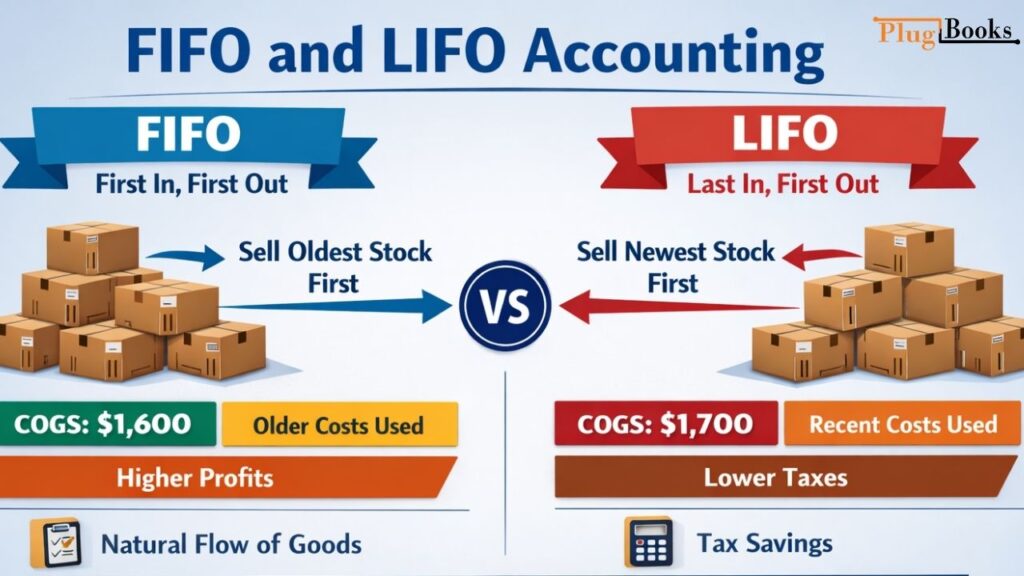
FIFO vs LIFO Impact on Profit Margin
During inflation:
- FIFO → Lower COGS → Higher reported profit
- LIFO → Higher COGS → Lower reported profit
Higher profit improves:
- Business valuation
- Investor confidence
- Loan approvals
However, LIFO may reduce taxable income.
Understanding the fifo vs lifo impact on profit margin helps ecommerce sellers plan growth and tax strategy properly.
How To Calculate FIFO and LIFO Accounting (COGS)
If you want to understand how to calculate cogs using fifo and lifo, follow these steps:
Step 1: Record Opening Inventory
Step 2: Track Purchases by Date
Step 3: Identify Units Sold
Step 4: Apply Method Logic
FIFO → Use oldest cost layers first
LIFO → Use newest cost layers first
For small sellers, this may be manageable manually. But once you process hundreds of daily orders across Shopify and Amazon, manual calculation becomes risky and inefficient.
Best Inventory Valuation Method for Shopify Sellers
Many entrepreneurs ask:
What is the best inventory valuation method for shopify sellers?
In most cases, FIFO is preferred because:
- It matches physical inventory flow
- It produces cleaner financial statements
- It reflects realistic ending inventory value
- It is widely accepted globally
When deciding the best inventory valuation method for shopify sellers, consider:
- Product type
- Price volatility
- Tax planning strategy
- Growth goals
Most growing Shopify brands lean toward FIFO in 2026.

FIFO vs LIFO for Amazon FBA Sellers
When evaluating fifo vs lifo for amazon fba sellers, you must consider:
- Amazon storage fees
- Restock cycles
- Multi-batch shipments
- Long-term inventory storage costs
Since FBA inventory often follows physical FIFO movement in warehouses, FIFO aligns better with operational reality.
However, some sellers analyze LIFO during inflation to reduce taxable income. That’s why the debate around fifo vs lifo for amazon fba sellers remains relevant.
Which Is Better FIFO or LIFO for Ecommerce Business?
A common question:
Which is better fifo or lifo for ecommerce business?
There is no universal answer. It depends on:
- Inflation environment
- Tax objectives
- Investor reporting needs
- Business maturity
Generally:
- Scaling brands seeking stronger financial reports → FIFO
- Businesses optimizing short-term taxes → LIFO
Your accounting strategy should match your growth strategy.
FIFO vs LIFO for Dropshipping Business 2026
Now let’s discuss fifo vs lifo for dropshipping business 2026.
Many dropshipping businesses:
- Do not hold physical inventory
- Purchase per order
- Use supplier-based costing
In pure dropshipping, FIFO/LIFO layers may not apply traditionally. However, if bulk purchasing or partial stock storage exists, FIFO is usually simpler and more practical.
In 2026, most hybrid dropshipping models adopt FIFO-style cost tracking for clarity.
How Online Sellers Choose Between FIFO and LIFO
Understanding how online sellers choose between fifo and lifo involves analyzing:
- Price trends
- Inventory turnover speed
- Compliance requirements
- Tax strategy
Smart ecommerce operators evaluate:
- The fifo vs lifo impact on profit margin
- Financial statement presentation
- Long-term scalability
Most start with FIFO due to simplicity and global acceptance.
Inventory Accounting Method for Small Ecommerce Business
Choosing the right inventory accounting method for a small ecommerce business is crucial in early stages.
Small sellers should prioritize:
- Simplicity
- Consistency
- Automation compatibility
- Accurate COGS tracking
FIFO is typically easier to implement and understand for startups.
As order volume grows, automated systems become necessary to avoid errors.
Common Inventory Accounting Mistakes
Ecommerce sellers often:
- Track inventory only in spreadsheets
- Recalculate COGS manually
- Mix FIFO and LIFO unintentionally
- Ignore batch-level costing
- Delay reconciliation
These errors distort profits and create compliance risks.
How Bookkeeping Software Handles FIFO and LIFO
Manual accounting doesn’t scale.
Modern systems automate:
- Cost layer tracking
- Real-time COGS calculation
- Multi-channel syncing
- Batch-level adjustments
- Financial report generation
Understanding how bookkeeping software handles fifo and lifo is essential for scaling ecommerce brands.
Automation reduces errors, improves compliance, and gives instant visibility into true profitability.

Why Ecommerce Sellers Use PlugBooks
For Shopify, Amazon FBA, and multi-channel sellers, PlugBooks provides:
✔ Real-time inventory tracking
✔ Accurate COGS calculation
✔ FIFO-based reporting clarity
✔ Multi-platform synchronization
✔ Automated financial statements
Instead of guessing margins, sellers gain reliable financial insight.
When deciding on fifo vs lifo for ecommerce sellers, implementation accuracy matters more than theory — and automation ensures consistency.
Security & Accuracy Tips
- Choose one method and apply it consistently
- Maintain detailed purchase records
- Reconcile inventory monthly
- Avoid switching methods without documentation
- Use secure cloud-based bookkeeping systems
Consistency protects your financial credibility.

Frequently Asked Questions
1. What is the main difference between FIFO and LIFO?
FIFO uses the oldest inventory first; LIFO uses the newest inventory first.
2. Which method increases reported profit?
During inflation, FIFO generally shows higher profit.
3. Is FIFO better for Shopify sellers?
In most cases, yes — it aligns with real inventory movement.
4. Can Amazon FBA sellers use LIFO?
Yes, depending on accounting standards and compliance rules.
5. Does dropshipping require FIFO or LIFO?
Pure dropshipping may not require layered costing, but hybrid models often use FIFO.
6. Can small ecommerce businesses change methods?
Yes, but changes require documentation and proper accounting adjustments.
Quick Recap
✔ fifo and lifo accounting are inventory valuation methods
✔ fifo vs lifo for ecommerce sellers affects profit and taxes
✔ how to calculate cogs using fifo and lifo can be complex at scale
✔ best inventory valuation method for shopify sellers is often FIFO
✔ fifo vs lifo for amazon fba sellers depends on tax and growth strategy
✔ fifo vs lifo for dropshipping business 2026 varies by model
✔ inventory accounting method for small ecommerce business should prioritize simplicity
✔ bookkeeping software ensures accurate automation
Final Thoughts
In 2026, ecommerce success is not just about driving sales — it’s about understanding real profitability.
Choosing between fifo vs lifo for ecommerce sellers is a financial strategy decision that impacts margins, taxes, and business valuation.
Smart online sellers don’t guess their numbers.
They systemize them.
They automate them.
They scale with clarity.
If you want accurate inventory tracking, automated COGS, and reliable financial reporting, adopting the right accounting system is no longer optional — it’s essential.