




If you’re selling on Amazon in 2026, you’ve probably faced this situation more than once.
You list a product at a profitable price. Sales start coming in. Everything looks stable.
Then suddenly, you check Walmart… and the same product is cheaper there.
That’s when every seller asks the same question:
Does Amazon price match Walmart?
At first glance, it feels like Amazon should adjust prices to stay competitive. After all, both platforms sell similar products to the same customers. But Amazon does not work like a traditional retail store.
This misunderstanding often leads sellers to:
- Lower prices too quickly
- Lose profit margins
- Compete in the wrong marketplace
- Confuse Walmart pricing with Amazon strategy
In this complete guide, we will break everything down in simple language so you understand:
- The real Amazon price matching policy
- How Walmart pricing actually affects Amazon sellers
- Why pricing behaves the way it does
- And how to protect your profit using smart tools like PlugBooks
Let’s get into it.
Does Amazon Price Match Walmart?
Let’s answer this clearly first:
No, Amazon does NOT price match Walmart.
Amazon has no official policy that adjusts or matches prices with Walmart, Target, or any other retailer.
This means:
- If Walmart sells something cheaper, Amazon does not automatically reduce your listing price
- You will not receive refunds or credits for price differences
- There is no system that compares Amazon vs Walmart pricing in real time
Amazon pricing is completely independent.
Instead of price matching, Amazon focuses on something else entirely:
Marketplace competition inside Amazon itself
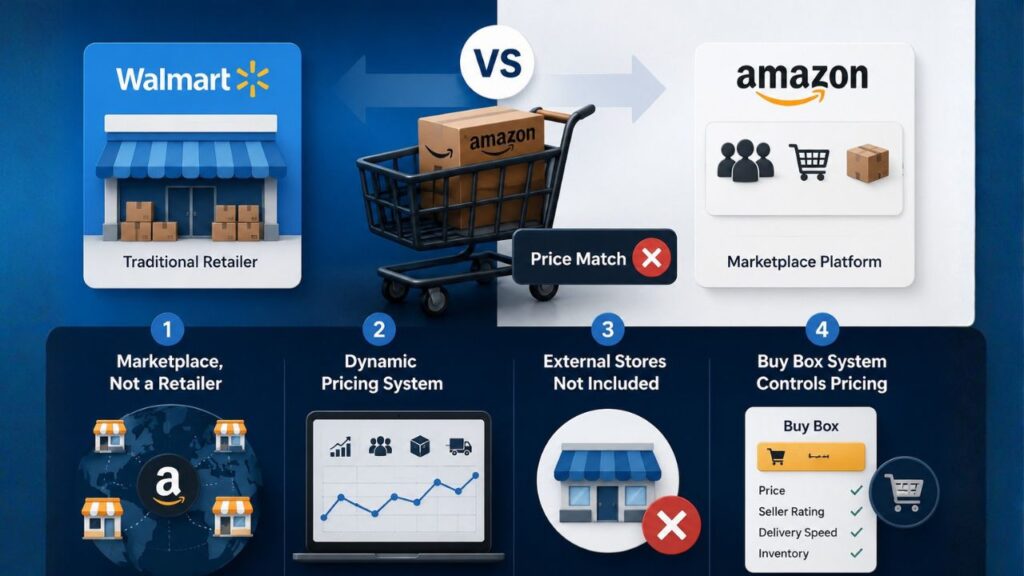
Why Amazon Does NOT Price Match Walmart
To understand this properly, you need to understand how Amazon works behind the scenes.
Amazon is not a traditional store like Walmart. It is a marketplace platform where millions of sellers compete.
Here’s why price matching does not exist:
1. Amazon is a Marketplace, Not a Retailer
Walmart sells products directly.
Amazon allows:
- Third-party sellers
- Amazon retail (in some cases)
- Global competition on one listing
Because of this complexity, fixed price matching would break the system.
2. Dynamic Pricing System
Amazon uses algorithm-based pricing that changes constantly based on:
- Demand levels
- Seller competition
- Stock availability
- Buy Box performance
- Shipping speed
Prices can change multiple times per day without any connection to Walmart.
3. External Stores Are Not Included
Walmart is treated as an external competitor, not part of Amazon’s pricing algorithm.
So Amazon does NOT track Walmart prices for adjustments.
4. Buy Box System Controls Pricing Behavior
Instead of price matching, Amazon uses the Buy Box system.
The Buy Box depends on:
- Price competitiveness on Amazon
- Seller rating
- Delivery speed
- Inventory stability
Walmart pricing is not part of this equation.
What Happens When Walmart Has Lower Prices?
Even though Amazon does not price match Walmart, Walmart still influences seller performance indirectly.
Here’s what usually happens in the real market:
Buyers Compare Manually
Customers often check:
- Amazon price
- Walmart price
- Delivery speed
- Trust level
If Walmart is cheaper, some buyers may switch.
Conversion Rate Drops
Even if your Amazon listing is strong, lower external prices can reduce:
- Click-through rate
- Conversion rate
- Overall sales volume
Increased Pressure on Sellers
Sellers often feel forced to reduce prices to stay competitive.
But this is where many sellers make mistakes.
Amazon is NOT reacting to Walmart
It is reacting to Amazon competition
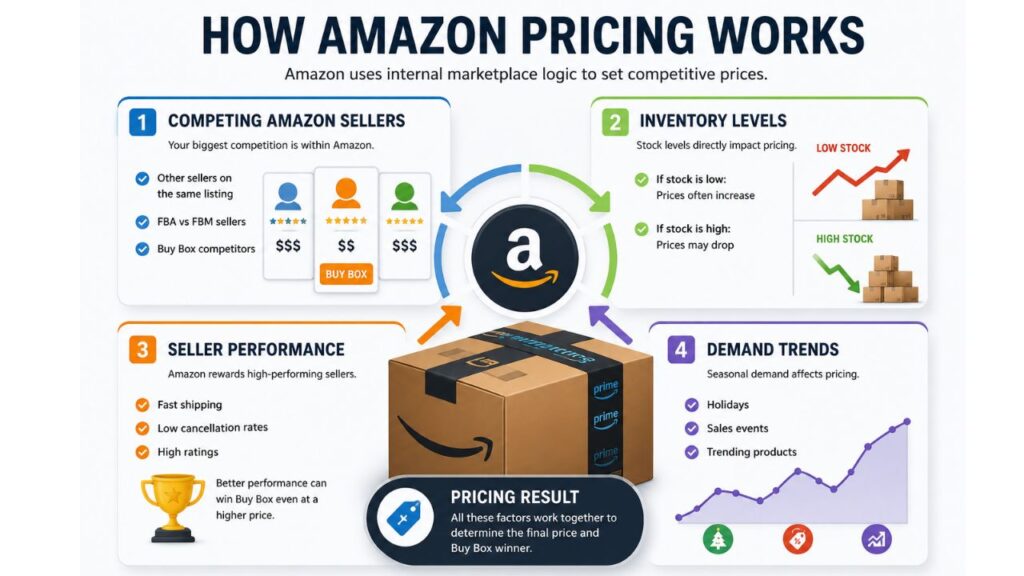
How Amazon Pricing Actually Works
This is where most confusion comes from.
Amazon pricing is based on internal marketplace logic, not external stores.
Here are the key factors:
1. Competing Amazon Sellers
Your biggest competition is:
- Other sellers on the same listing
- FBA vs FBM sellers
- Buy Box competitors
2. Inventory Levels
If stock is low:
- Prices often increase
If stock is high: - Prices may drop
3. Seller Performance
Amazon rewards:
- Fast shipping
- Low cancellation rates
- High ratings
Better performance can win Buy Box even at a higher price.
4. Demand Trends
Seasonal demand affects pricing:
- Holidays
- Sales events
- Trending products
Key Insight
Amazon does NOT care what Walmart is doing
It only cares what is happening inside Amazon
Should Sellers Match Walmart Prices?
This is where most sellers lose money.
The short answer:
No, not blindly.
Matching Walmart prices without analysis can destroy your profit margins.
Instead, ask:
- What is my Amazon fee structure?
- What is my break-even price?
- What is my Buy Box strategy?
- Am I even competing with Walmart customers?
Sometimes Walmart pricing is irrelevant to your Amazon audience.
Smart Seller Strategies
If you want to survive and grow on Amazon, you need strategy—not price panic.
1. Focus on Profit, Not Just Sales
A lower price may increase sales, but:
- It reduces profit
- It weakens long-term stability
Always calculate net margin.
2. Use Minimum Price Rules
Set:
- Minimum profit per unit
- Minimum ROI threshold
- Safe discount range
Never go below break-even.
3. Compete Inside Amazon Only
Ignore Walmart pricing for daily decisions.
Instead track:
- Amazon Buy Box price
- Competing Amazon sellers
- Your own listing performance
4. Improve Listing Value Instead of Cutting Price
Better listings can beat lower prices:
- Strong SEO titles
- High-quality images
- Clear bullet points
- A+ content
- Bundles and offers
5. Use Data Instead of Emotion
Most sellers make emotional pricing decisions.
Don’t react—analyze.
Common Mistakes Amazon Sellers Make
Here are the biggest profit killers:
Copying Walmart prices directly
Ignoring Amazon fees
Over-discounting to win Buy Box
Not tracking real profit per order
Reacting to competitors too quickly
These mistakes can turn profitable products into loss-making listings.
How PlugBooks Helps Sellers Stay Profitable
When pricing becomes confusing, data becomes your strongest weapon.
PlugBooks Official Site helps Amazon and eBay sellers understand real profit—not just revenue.
Instead of guessing pricing decisions, PlugBooks allows you to:
- Track real-time profit margins
- Monitor cross-platform performance
- Sync Amazon, eBay, QuickBooks, and Xero data
- Understand true cost per sale
Why this matters
Because Walmart pricing is only part of the picture. Your real success depends on:
- Net profit
- Fee structure
- Operational costs
- Return rates
PlugBooks helps you see the full financial picture so you don’t underprice your business.

FAQs
Does Amazon price match Walmart in 2026?
No, Amazon does not offer price matching with Walmart or other retailers.
Why is Walmart sometimes cheaper?
Walmart is often cheaper because it uses different supply chains, bulk pricing, and retail strategies.
Can Walmart affect Amazon sales?
Yes, but only indirectly. Customers compare prices, which can impact Amazon conversions and sales.
Should I always match competitor prices?
No. You should only match prices if your profit margins remain safe and sustainable.
What is the safest pricing strategy for Amazon sellers?
The safest strategy is to focus on Amazon competition, track your Buy Box price, and protect your minimum profit margin.
How do I look up item numbers at Walmart?
You can look up item numbers at Walmart by searching the product on Walmart.com or using the Walmart app. The item number is usually shown in the product details section as SKU or UPC.
Quick Recap
- Amazon does NOT price match Walmart
- Pricing is controlled by Amazon algorithms
- Walmart affects buyers, not Amazon pricing system
- Smart sellers focus on profit, not lowest price
- Data tools help prevent pricing mistakes
Conclusion
So, let’s make it simple:
Amazon does not price match Walmart in 2026.
But Walmart still influences buyer behavior, which means sellers must stay smart—not reactive.
If you want long-term success on Amazon, don’t chase every external price drop. Instead:
- Understand your real margins
- Compete inside Amazon marketplace
- Focus on value, not just price
And most importantly, use data-driven tools like PlugBooks to make sure every pricing decision is profitable—not emotional.
Because in 2026, winning on Amazon is not about being the cheapest…
👉 It’s about being the smartest seller in the market.
