



If you run an online store, understanding your financial health is the difference between scaling up and shutting down. At the heart of this financial clarity is your profit and loss statement. Often called an income statement, this core financial report gives you a crystal-clear look at your revenue, costs, and net income over a specific period.
Whether you are preparing for tax season, looking for outside funding, or simply trying to figure out why your margins feel tight, mastering your financial statements is non-negotiable. In this guide, we will break down everything you need to know about tracking your business performance, managing your numbers, and using your financial data to make smarter business decisions.
What is a Profit and Loss Statement?
A profit and loss statement is a financial document that summarizes the revenues, costs, and expenses incurred during a specific period—typically a month, quarter, or year. It answers the most fundamental question in business: Are we actually making money?
For online retailers, this report accounts for every dollar coming in from customer purchases and every dollar going out for inventory, shipping supplies, software subscriptions, and marketing campaigns.
What is a P&L Statement? (Core Components)
To truly understand what is a p&l statement, you need to look at its structural building blocks. Every standard income statement is built on a simple formula: Net Income = Revenue – Expenses.
1. Revenue (Top Line)
Revenue represents the total amount of money generated from the sale of goods or services before any expenses are deducted. In ecommerce, this includes product sales, shipping fees collected, and digital product downloads.
2. Cost of Goods Sold (COGS)
COGS includes all direct costs tied directly to creating or acquiring the products you sell. This encompasses raw materials, manufacturing costs, wholesale inventory purchases, and custom packaging.
3. Gross Profit
Gross profit is calculated by subtracting COGS from total revenue. It shows how efficiently you produce or source your items before accounting for operating overhead.
4. Operating Expenses (OpEx)
OpEx covers the indirect costs required to keep your business running day-to-day. For online stores, this includes Shopify fees, Facebook ad spend, email marketing software, warehouse rent, and merchant processing fees.
5. Net Income (Bottom Line)
Net income is what remains after subtracting all operating expenses, taxes, and interest from your gross profit. If this number is positive, you are profitable. If it is negative, you are operating at a net loss.
Balance Sheet vs. Profit and Loss
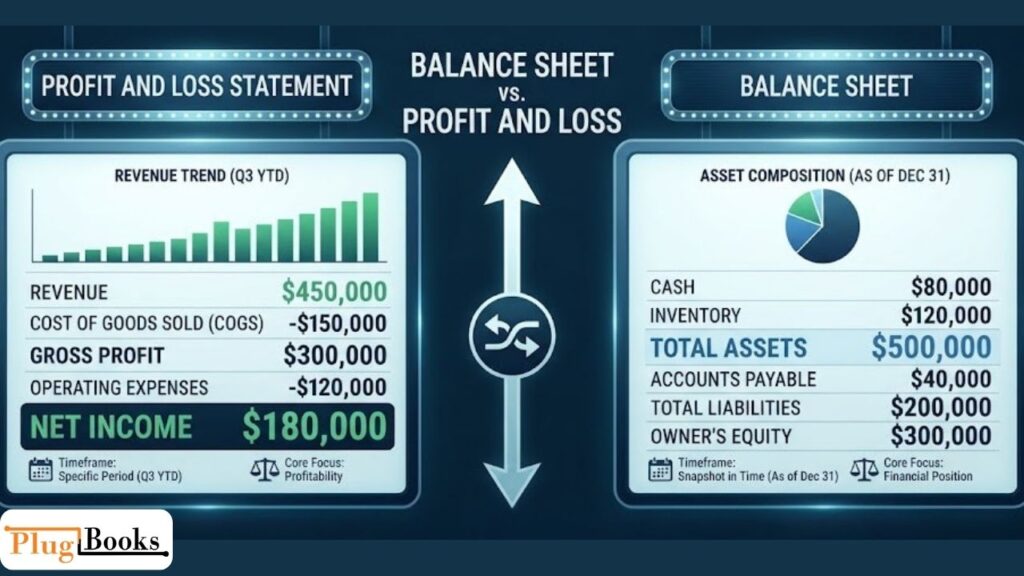
Business owners often confuse financial statements, particularly the income statement and the balance sheet. While both are essential, they tell two entirely different stories.
| Feature | Profit and Loss Statement | Balance Sheet |
| Timeframe | Covers a specific period (e.g., Q3, Year-to-Date) | Snapshot in time (e.g., as of December 31) |
| Core Focus | Tracks profitability, revenues, and expenses | Tracks financial position, assets, and liabilities |
| Primary Formula | Revenue – Expenses = Net Income | Assets = Liabilities + Equity |
| Main Purpose | Measures operational performance and growth | Evaluates business net worth and solvency |
P&L Management for Ecommerce Growth
Effective p&l management goes beyond simply filing taxes at year-end. By reviewing your numbers monthly, you can spot unhealthy spending trends early.
- Monitor Customer Acquisition Cost (CAC): Track how much your ad spend eats into your gross margins.
- Audit Subscriptions: Identify forgotten SaaS tools draining your operating expenses.
- Seasonal Adjustments: Compare Q4 holiday performance against Q1 slow seasons to forecast cash flow needs.
Step-by-Step Guide: How to Read a P&L Statement
Analyzing your financial statements does not require a degree in accounting. Follow these steps to extract actionable insights:
- Review Total Revenue Growth: Compare your current month’s top line against the previous month and the same month last year. Is sales volume growing?
- Examine Gross Margins: Calculate your gross margin percentage. If it is shrinking, your supplier costs may be rising faster than your retail prices.
- Scrutinize Advertising Efficiency: Look at your marketing expenses relative to your revenue. Are your ads generating a healthy return on ad spend (ROAS)?
- Check the Bottom Line: Verify whether your net profit is expanding or contracting over time.
Balance Sheet vs Profit and Loss
A balance sheet and a profit and loss statement answer different financial questions.
| Feature | Profit & Loss Statement | Balance Sheet |
| Main purpose | Measures financial performance | Shows financial position |
| Time perspective | Covers a period | Shows a specific date |
| Main items | Revenue, costs, expenses, profit | Assets, liabilities, equity |
| Key question | Did the business make money? | What does the business own and owe? |
| Common use | Profitability analysis | Financial position and liquidity |
For example, an ecommerce business can show a profit on its P&L while still having cash tied up in inventory or money owed to suppliers.
That is why the P&L should be reviewed alongside the balance sheet and cash flow statement.
Sample Profit and Loss Considerations for Multifamily Property
While ecommerce businesses focus on inventory and digital ads, other industries have distinct P&L structures. For instance, a sample profit and loss statement for multifamily property will look quite different from an online retail store. Real estate P&Ls focus heavily on rental income, property management fees, maintenance repairs, property taxes, and mortgage interest rather than physical inventory and shipping costs.
Expert Tips for Better Financial Reporting
- Automate Your Bookkeeping: Integrate accounting software like QuickBooks or Xero directly with your ecommerce platform (Shopify, WooCommerce, or Amazon).
- Use Accrual Accounting: Track revenue when earned and expenses when incurred rather than just cash flow for a true picture of profitability.
- Keep Personal Expenses Separate: Never mix personal purchases with business accounts; it muddies your P&L accuracy.
Seamless Financial Management with PlugBooks
Streamline your ecommerce accounting effortlessly by connecting PlugBooks to your online store. This powerful integration automates transaction logging, reconciles sales from platforms like Shopify and Amazon, and syncs your financial data directly with accounting frameworks like QuickBooks and Xero. By eliminating manual data entry, PlugBooks ensures your profit and loss statements stay accurate in real time, giving you crystal-clear visibility into your true business margins and cash flow.

Common Mistakes to Avoid
- Ignoring Merchant Fees: Failing to account for Stripe, PayPal, or Shopify Payments processing fees in your expense logs.
- Neglecting Inventory Shrinkage: Forgetting to write off damaged, stolen, or lost stock, which skews your COGS calculations.
- Inconsistent Reporting: Reviewing your numbers sporadically instead of establishing a strict monthly cadence.
Frequently Asked Questions
What is a profit and loss statement?
It is a financial report summarizing a company’s revenues, costs, and expenses over a specific accounting period to show net profit or loss.
How often should I check my P&L statement?
You should review your P&L statement at the close of every single month to catch cash flow issues and operational inefficiencies early.
What is the difference between a P&L statement and a balance sheet?
A P&L measures profitability over a timeframe, while a balance sheet provides a snapshot of what your business owns and owes at a specific moment.
Does a P&L statement track cash flow?
Not entirely. A P&L operates largely on accrual principles, meaning it records sales and expenses when they occur, not necessarily when cash changes hands.
What is included in the Cost of Goods Sold (COGS) for ecommerce?
COGS includes product manufacturing costs, wholesale purchase prices, raw materials, freight-in shipping fees, and custom packaging.
Why is P&L management important for online stores?
It helps retailers identify which products are actually profitable after factoring in high advertising and shipping expenses.
Can I create a profit and loss statement in Excel?
Yes, many small business owners start with Excel or Google Sheets templates before upgrading to automated accounting software.
What is net income on an income statement?
Net income is the final amount remaining after all operating expenses, taxes, and costs are subtracted from total revenue.
Conclusion
Your ecommerce profit and loss statement is much more than a mandatory tax document—it is the ultimate dashboard for your business health. By mastering your financial reporting, tracking your gross margins closely, and practicing disciplined P&L management, you can make confident decisions that scale your revenue and protect your bottom line.
